Question
An unruly demonstrator lifts a stone of mass 200g from the ground and throws it at his opponent. At the time of projection, the stone is 150cm above the ground and has a speed of 3.00m/s. Calculate the work done by the demonstrator during the process. If it takes one second for the demonstrator to lift the stone and throw, what horsepower does he use?
Answer

m = 200g = 0.2kg, h = 150cm = 1.5m, v = 3m/sec, t = 1sec Total work done $=\frac{1}{2}\text{mv}^2+\text{mgh}$ $=\Big(\frac{1}{2}\Big)\times(0.2)\times9+(0.2)\times(9.8)\times(1.5)=3.84\text{J}$ h.p. used $=\frac{3.84}{746}=5.14\times10^{-3}$

Need a full question paper?

Generate a complete, print-ready paper with questions like this in minutes — across 16+ boards, with answer keys.

Start Generating Free

Similar questions

The heart rate (number of heart beats per minute) scales as $\frac{1}{\text{L}}$ where L is the characteristic length of the mammal. Can you explain this? If the scale factor of a human relative to a rhesus monkey is about 2.5, what is the monkey's heart rate?
A ball is projected from a point on the floor with a speed of 15m/s at an angle of 60° with the horizontal. Will it hit a vertical wall 5m away from the point of projection and perpendicular to the plane of projection without hitting the floor? Will the answer differ if the wall is 22m away?
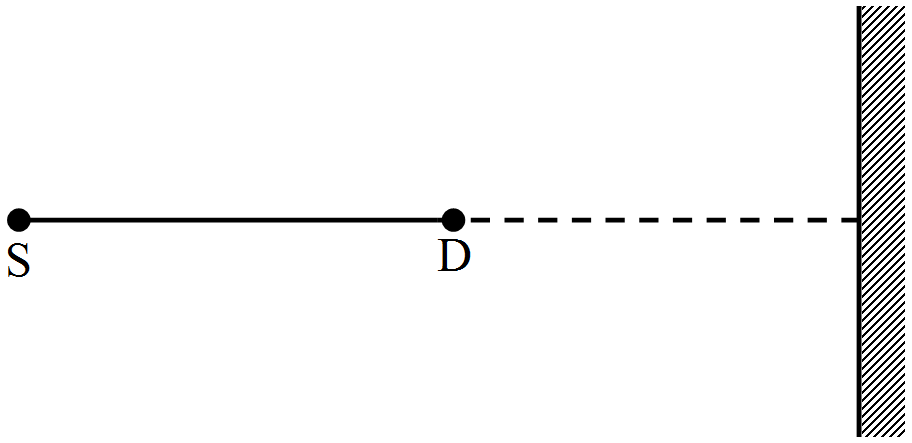
A source of sound S and a detector D are placed at some distance from one another. A big cardboard is placed near the detector and perpendicular to the line SD as shown in figure, It is gradually moved away and it is found that the intensity changes from a maximum to a minimum as the board is moved through a distance of 20cm. Find the frequency of the sound emitted. Velocity of sound in air is 336m/s.
A layer of ice of 20 cm thickness accumulates on the surface of the water of a pond. The temperature of air is $-10^{\circ} C$. The thickness of the ice layer is 0.1 cm, how long will the increase take? The conductivity of ice is $2.1 \text {Joule}~ \text {sec} ^{-1} m^{-1} k ^{-1}$, latent heat $3.36 \times 10^5 \text {Joule}~\text {kg} ^{-1}$ and density $10^3$.
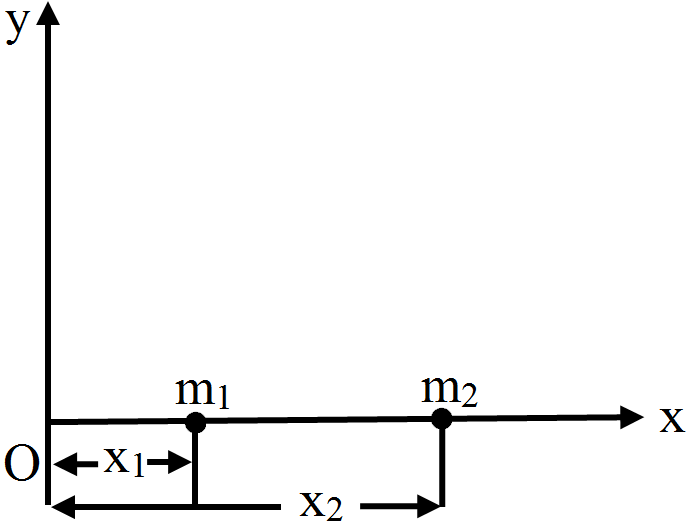
What will be the centre of mass of the pair of particles described below in figure on the x-axis?
Consider a simple pendulum, having a bob attached to a string, that oscillates under the action of the force of gravity. Suppose that the period of oscillation of the simple pendulum depends on its length (l), mass of the bob (m) and acceleration due to gravity (g). Derive the expression for its time period using method of dimensions.
What is viscosity?
Explain why cooking is faster in a pressure cooker.
Why should a bat be able to sense high frequencies?
Calculate the mass of $1 \mathrm{~cm}^3$ of oxygen kept at STP.