Question
An unruly demonstrator lifts a stone of mass 200g from the ground and throws it at his opponent. At the time of projection, the stone is 150cm above the ground and has a speed of 3.00m/s. Calculate the work done by the demonstrator during the process. If it takes one second for the demonstrator to lift the stone and throw, what horsepower does he use?
Answer

m = 200g = 0.2kg, h = 150cm = 1.5m, v = 3m/sec, t = 1sec Total work done $=\frac{1}{2}\text{mv}^2+\text{mgh}$$=\Big(\frac{1}{2}\Big)\times(0.2)\times9+(0.2)\times(9.8)\times(1.5)=3.84\text{J}$
h.p. used $=\frac{3.84}{746}=5.14\times10^{-3}$

Need a full question paper?

Generate a complete, print-ready paper with questions like this in minutes — across 16+ boards, with answer keys.

Start Generating Free

Similar questions

A material has poission's ratio 0.5. If a uniform rod of it undergoes a longitudinal strain of $2 \times 10^{-3}$. What is the percentage increases in its volume.
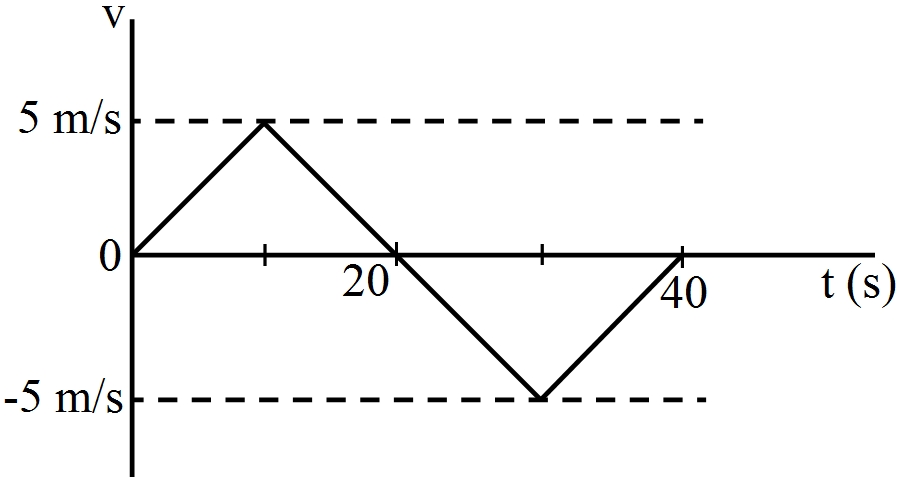
From the velocity-time plot shown in figure, find the distance travelled by the particle during the first 40 seconds. Also find the average velocity during this period.
Why does a phonograph-record attract dust particles just after it is cleaned?
The eyepiece of an astronomical telescope has a focal length of 10cm. The telescope is focused for normal vision of distant objects when the tube length is 1.0m. Find the focal length of the objective and the magnifying power of the telescope.
The period of simple harmonic motion of a body suspended from a spring is cut the spring into two equal parts.
(a) Hang the same body from one spring and make it oscillate, then find the time period.
(b) What will be the period of oscillation if both the pieces are connected in parallel and oscillated?
Which of the two will increase the pressure more-an adiabatic or an isothermal process in reducing the volume to 50%?
A copper wire of cross-sectional area $0.01cm^2$ is under a tension of 20N. Find the decrease in the cross-sectional area. Young's modulus of copper = $1.1 \times 10 ^{11}N/m^2$ and Poisson's ratio = 0.32.$\Big[$Hint: $\frac{\triangle\text{A}}{\text{A}}=2\frac{\triangle\text{r}}{\text{r}}\Big]$
A metal block of area $0.10 m ^2$ is connected to a $0.010 kg$ mass via a string that passes over an ideal pulley $($considered massless and frictionless), as in Fig. $9.13$. A liquid with a film thickness of $0.30 mm$ is placed between the block and the table. When released the block moves to the right with a constant speed of $0.085 m s ^{-1}$. Find the coefficient of viscosity of the liquid.
A block of mass M is held against a rough vertical wall by pressing it with a finger. If the coefficient of friction between the block and the wall is $\mu$ and the acceleration due to gravity is g, calculate the minimum force required to be applied by the finger to hold the block against the wall?
Consider two particles A and B having equal charges and placed at some distance. The particle A is slightly displaced towards B. Does the force on B increase as soon as the particle A is displaced? Does the force on the particle A increase as soon as it is displaced?