Question
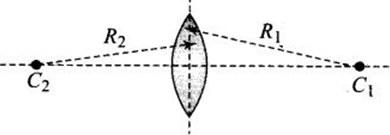
An unsymmetrical double convex thin lens forms the image of a point object on its axis. Will the position of the image change if the lens is reversed?
Answer

Key concept: Thin lens formula: $\frac{1}{\text{v}}-\frac{1}{\text{u}}=\frac{1}{\text{f}}$

For a given object position if focal length of the lens deos not change, the image posrition remains unchanged.

By lens maker's formula,

$\frac{1}{\text{f}}=(\mu-1)\Big(\frac{1}{\text{R}_1}+\frac{1}{\text{R}_2}\Big)$

For this position R1 is positive and R2 is negative. Hence focal lenght at this position

$\frac{1}{\text{f}_1}=(\mu-1)\Big(\frac{1}{(+\text{R}_1)}-\frac{1}{(-\text{R}_2)}\Big)=(\mu-1)\Big(\frac{1}{\text{R}_1}+\frac{1}{\text{R}_2}\Big)$

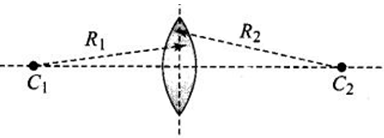
Now the lens is reversed,

At this position, R2 is positive and R1 is negative. Hence focal length at this position is

$\frac{1}{\text{f}_2}=(\mu-1)\Big(\frac{1}{(+\text{R}_2)}-\frac{1}{(-\text{R}_1)}\Big)=(\mu-1)\Big(\frac{1}{\text{R}_1}+\frac{1}{\text{R}_2}\Big)$

We can observe the focal length of the lens does not change in both positions, hence the image position remains unchanged.
Need a full question paper?

Generate a complete, print-ready paper with questions like this in minutes — across 16+ boards, with answer keys.

Start Generating Free

Similar questions

Define common potential. Find the expression for redistribution of charges and energy loss when capacitors are connected together.
Calculate the Q-values of the following fusion reactions:
  1. $\text{ }^2_1\text{H}+\text{ }^2_1\text{H}\rightarrow\text{ }^3_1\text{H}+\text{ }^1_1\text{H}$
  2. $\text{ }^2_1\text{H}+\text{ }^2_1\text{H}\rightarrow\text{ }^3_2\text{H}+\text{n}$
  3. $\text{ }^2_1\text{H}+\text{ }^3_1\text{H}\rightarrow\text{ }^4_1\text{H}+\text{n}$
Atomic masses are
$\text{m}\big(\text{ }^2_1\text{H}\big)=2.014102\text{u}$
$\text{m}\big(\text{ }^3_1\text{H}\big)=3·016049\text{u}$
$\text{m}\big(\text{ }^3_2\text{H}\big)=3.016029\text{u}$
$\text{m}\big(\text{ }^4_2\text{He}\big)=4·002603\text{u}$
Explain Oersted's experiment. What conclusions were drawn from it? What do you understand by magnetic field? How direction and intensity of magnetic field determined?
An apple falls from a tree. An insect in the apple finds that the earth is falling towards it with an acceleration g. Who exerts the force needed to accelerate the earth with this acceleration g?
Do the same exercise as above with the replacement of the earlier transformer by a 40, 000-220V step-down transformer (Neglect, as before, leakage losses though this may not be a good assumption any longer because of the very high voltage transmission involved). Hence, explain why high voltage transmission is preferred?
Two small spheres, each having a mass of 20g, are suspended from a common point by two insulating strings of length 40cm each. The spheres are identically charged and the separation between the balls at equilibrium is found to be 4cm. Find the charge on each sphere.
Two ideal gases have the same value of $\frac{\text{C}_\text{P}}{\text{C}_\text{V}}=\gamma.$ What will be the value of this ratio for a mixture of the two gases in the ratio 1 : 2?
Find an expression for the electric field strength at a distant point situated (i) on the axis and (ii) along the equatorial line of an electric dipole.

OR

Derive an expression for the electric field intensity at a point on the equatorial line of an electric dipole of dipole moment $\vec{\text{p}}$ and length 2a. What is the direction of this field?

In an intrinsic semiconductor the energy gap Eg is 1.2eV. Its hole mobility is much smaller than electron mobility and independent of temperature. What is the ratio between conductivity at 600K and that at 300K? Assume that the temperature dependence of intrinsic carrier concentration ni is given by,
$\text{n}_{\text{i}}=\text{n}_{\text{0}}\ {\text{exp}}\Big(-\frac{\text{E}_\text{g}}{2{\text{K}_{\text{B}}}{\text{T}}}\Big)$
where n0 is a constant.
A capacitor of capacitance C is given a charge Q. At t = 0, it is connected to an uncharged capacitor of equal capacitance through a resistance R. Find the charge on the second capacitor as a function of time.