Question

 and  represents gravitational and electrostatic force respectively between electrons situated at a distance 10 cm. The ratio of  is of the order of

(a)   

(b) 10

(c) 1  

(d)  

Answer

(d)  

Need a full question paper?

Generate a complete, print-ready paper with questions like this in minutes — across 16+ boards, with answer keys.

Start Generating Free

Similar questions

According to Bohr’s model of hydrogen atom:

In good conductors of electricity, the type of bonding that exists is

(a) Ionic  

(b) Vander Waals

(c) Covalent

(d) Metallic

P-type semiconductors are made by adding impurity element

(a) As      

(b) P

(c) B 

(d) Bi

Consider three quantities $\text{x}=\frac{\text{E}}{\text{B}},\ \text{y}=\sqrt{\frac{1}{\mu_0\in_0}}$ and $\text{z}=\frac{1}{\text{CR}}.$ Here, l is the length of a wire, C is a capacitance and R is a resistance. All other symbols have standard meanings.
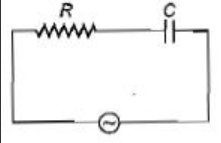
A 50 Hz, 20 V AC source is connected across R series circuit as shown in Figure If the voltage across R is 12V then voltage across capacitor is.
Image
The value of electric potential of a distance $r$ from a point charge $q$ is :

The electric field due to a uniformly charged sphere of radius R as a function of the distance from its centre is represented graphically by

(a)

(b)

(c)

(d)

The total mechanical energy of a spring-mass system in 1 simple harmonic motion is $\text{E}=\frac{1}{2}\text{m}\omega^2\text{A}^2.$ Suppose the oscillating particle is replaced by another particle of double the mass while the amplitude A remains the same. The new mechanical energy will:
  1. Become 2E
  2. Become $\frac{\text{E}}{2}$
  3. Become $\sqrt{2\text{E}}$
  4. Remain E.

The power of two convex lenses A and B are 8 diopters and 4 diopters respectively. If they are to be used as a simple microscope, the magnification of

(a) B will be greater than A  

(b) A will be greater than B 

(c) The information is incomplete 

(d) None of the above 

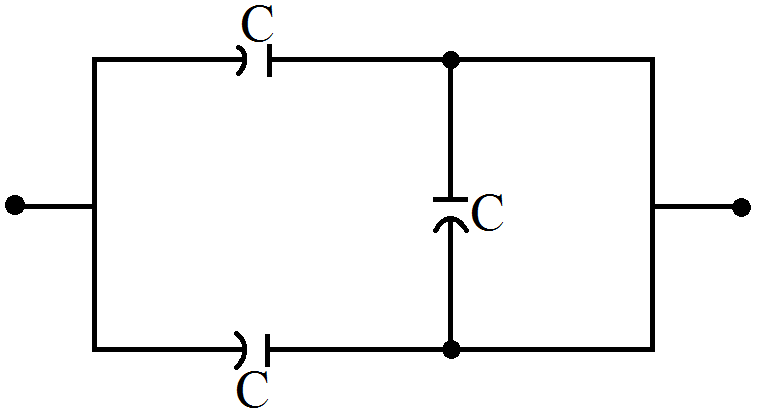
The equivalent capacitance of the combination shown in figure is:

  1. C
  2. 2C
  3. $\frac{\text{C}}{2}$
  4. None of these.