MCQ
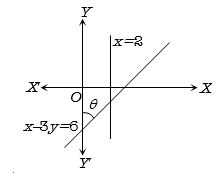
Angle between $x = 2$ and $x - 3y = 6$ is
  • A
    $\infty $
  • ${\tan ^{ - 1}}(3)$
  • C
    ${\tan ^{ - 1}}\left( {\frac{1}{3}} \right)$
  • D
    None of these

Answer

Correct option: B.
${\tan ^{ - 1}}(3)$
b
(b) $\theta = {90^o} - {\tan ^{ - 1}}\left( {\frac{1}{3}} \right)$

$\tan \theta = \cot \left[ {{{\tan }^{ - 1}}\left( {\frac{1}{3}} \right)} \right] = 3$

$ \Rightarrow \theta = {\tan ^{ - 1}}(3)$.
Need a full question paper?

Generate a complete, print-ready paper with questions like this in minutes — across 16+ boards, with answer keys.

Start Generating Free

Similar questions

One card is drawn from a pack of $52$ cards. The probability that it is a king or diamond is
The equation of the common tangent to the curves ${y^2} = 8x$ and $xy = - 1$ is
The area of the parallelogram whose adjacent sides are $i - k$ and $2j + 3k$ is
${ }^{n-1} C_r=\left(k^2-8\right){ }^n C_{r+1}$ if and only if:
Direction ratios of the line represented by the equation $x = ay + b,$ $z = cy + d$ are
If ${a^2},\,{b^2},\,{c^2}$ be in $A.P.$, then $\frac{a}{{b + c}},\,\frac{b}{{c + a}},\,\frac{c}{{a + b}}$ will be in
Let $\mathrm{A}=\{1,2,3, \ldots, 10\}$ and R be a relation on A such that $R=\{(a, b): a=2 b+1\}$. Let $\left(a_{1}, a_{2}\right)$, $\left(a_{2}, a_{3}\right),\left(a_{3}, a_{4}\right), \ldots .,\left(a_{k}, a_{k+1}\right)$ be a sequence of $k$ elements of R such that the second entry of an ordered pair is equal to the first entry of the next ordered pair. Then the largest integer k, for which such a sequence exists, is equal to :
Let $f: R \rightarrow R$ be a continuous function satisfying $f(x)+\int \limits_0^x t f(t) d t+x^2=0$,for all $x \in R$. Then
The distance between the focii of the ellipse $(3x - 9)^2 + 9y^2 =(\sqrt 2 x + y +1)^2$ is-
Let $\vec{a}, \vec{b}, \vec{c}$ be three vectors such that $|\overrightarrow{ a }|=\sqrt{31}, 4|\overrightarrow{ b }|=|\overrightarrow{ c }|=2$ and $2(\overrightarrow{ a } \times \overrightarrow{ b })=3(\overrightarrow{ c } \times \overrightarrow{ a })$. If the angle between $\vec{b}$ and $\vec{c}$ is $\frac{2 \pi}{3}$, then $\left(\frac{\vec{a} \times \vec{c}}{\vec{a} \cdot \vec{b}}\right)^2$ is equal to $............$.