MCQ
Angle that the vector $\vec{\text{A}}=2\hat{\text{i}}+2\hat{\text{j}}$ makes with $y-$axis is:
  • A
    $\tan^{-1}\Big(\frac{3}{2}\Big)$
  • $\tan^{-1}\Big(\frac{2}{3}\Big)$
  • C
    $\sin^{-1}\Big(\frac{2}{3}\Big)$
  • D
    $\cos^{-1}\Big(\frac{3}{2}\Big)$

Answer

Correct option: B.
$\tan^{-1}\Big(\frac{2}{3}\Big)$
As $\vec{\text{A}}=2\hat{\text{i}}+2\hat{\text{j}},$
therefore $A_x = 2$ and $A_y = 3.$ If $\theta$ is the angle which $\vec{\text{A}}$ encloses with $y-$axis, then.
$\tan\theta=\frac{\text{A}_\text{x}}{\text{A}_\text{y}}=\frac{2}{3}$ or $\theta=\tan^{-1}\Big(\frac{2}{3}\Big)$

Need a full question paper?

Generate a complete, print-ready paper with questions like this in minutes — across 16+ boards, with answer keys.
Start Generating Free

Similar questions

The position of a projectile launched from the origin at $t=0$ is given by $\vec{r}=(40 \hat{i}+50 \hat{j}) m$ at $t=$ $2 s$. If the projectile was launched at an angle $\theta$ from the horizontal, then $\theta$ is (take $g =10\,ms ^{-2}$ )
The angle turned by a body undergoing circular motion depends on time as $\theta = {\theta _0} + {\theta _1}t + {\theta _2}{t^2}$. Then the angular acceleration of the body is
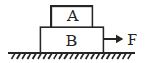
In figure, the coefficient of friction between the floor and the block $B$ is $0.1$. The coefficient of friction between the blocks $B$ and $A$ is $0.2$. The mass of $A$ is $\frac{m}{2}$  and of $B$ is $m$. ........ $mg$  is the maximum horizontal force $F$ can be applied to the block $B$ so that two blocks move together ?
Centripetal acceleration of a cyclist completing $7$ rounds in a minute along a circular track of radius $5 \,m$ with a constant speed, is ......... $m / s ^2$
A body starts from rest with uniform acceleration. If its velocity after $n$ second is $\upsilon ,$ then its displacement in the last two seconds is
From a stationary tank of mass $125000$ pound a small shell of mass $25$ pound is fired with a muzzle velocity of $1000\, ft/sec$. The tank recoils with a velocity of ............ $\mathrm{ft/sec}$
$A$ man weighing $80\, kg$ is standing at the centre of a flat boat and he is $20\, m$ from the shore. He walks $8\, m$ on the boat towards the shore and then halts. The boat weight $200\, kg$. ........ $m$ far is he from the shore at the end of this time.
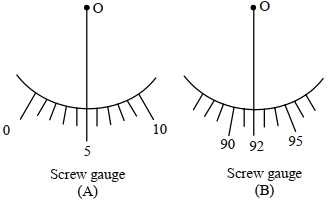
Student $A$ and Student $B$ used two screw gauges of equal pitch and $100$ equal circular divisions to measure the radius of a given wire. The actual value of the radius of the wire is $0.322\, {cm}$. The absolute value of the difference between the final circular scale readings observed by the students $A$ and $B$ is .... .

[Figure shows position of reference $'O'$ when jaws of screw gauge are closed]

Given pitch $=0.1 \,{cm}$.
The dimensions of angular momentum , latent heat and capacitance are, respectively.
Least count of a vernier caliper is $\frac{1}{20 \mathrm{~N}} \mathrm{~cm}$. The value of one division on the main scale is $1 \mathrm{~mm}$. Then the number of divisions of main scale that coincide with $\mathrm{N}$ divisions of vernier scale is :