MCQ
Angular displacement $(\theta )$ of a flywheel varies with time as $\theta  = at + b{t^2} + c{t^3}$ then angular acceleration is given by  
  • A
    $a + 2bt - 3c{t^2}$
  • B
     $2b - 6t$
  • C
    $a + 2b - 6t$
  •   $2b + 6ct$

Answer

Correct option: D.
  $2b + 6ct$
d
(d)   Angular acceleration $\alpha  = \frac{{{d^2}\theta }}{{d{t^2}}} = \frac{{{d^2}}}{{d{t^2}}}(at + b{t^2} + c{t^3})$$ = 2b + 6ct$

Need a full question paper?

Generate a complete, print-ready paper with questions like this in minutes — across 16+ boards, with answer keys.
Start Generating Free

Similar questions

A train is moving along a straight line with a constant acceleration ' $a$ '. A boy standing in the train throws a ball forward with a speed of $10 \ m / s$, at an angle of $60^{\circ}$ to the horizontal. The boy has to move forward by $1.15 \ m$ inside the train to catch the ball back at the initial height. The acceleration of the train, in $m / s ^2$, is
Assume that, the drag force on a football depends only on the density of the air, velocity of the ball and the cross-sectional area of the ball. Balls of different sizes but the same density are dropped in an air column. The terminal velocity reached by balls of masses $250 \,g$ and $125 \,g$ are in the ratio
Consider the quantity $\frac{\text{MkT}}{\text{pV}}$ of an ideal gas where $M$ is the mass of the gas. It depends on the,
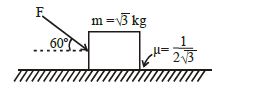
What is the maximum value of the force $F$ such that the block shown in the arrangement does not move ....... $N$
Consider the following statements

Assertion $(A)$ : $A$ cyclist always bends inwards while negotiating a curve

Reason $(R)$ : By bending he lowers his centre of gravity Of these statements,

If in winter season the surface temperature of lake is $1^{\circ} C$, the temperature at the bottom of lake will be ............
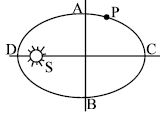
Figure shows the orbit of a planet $P$ round the sun $S.$ $AB$ and $CD$ are the minor and major axes of the ellipse.

If $U$ is the potential energy and $K$ kinetic energy then $|U| > |K|$ at
What is the maximum number of rectangular components into which a vector can be split in space?
In one dimensional motion, instantaneous speed $v$ satisfies $0\le\text{v}<\text{v}_0.$
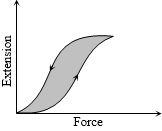
The diagram shows a force-extension graph for a rubber band. Consider the following statements

$I.$ It will be easier to compress this rubber than expand it

$II.$ Rubber does not return to its original length after it is stretched

$III.$ The rubber band will get heated if it is stretched and released

Which of these can be deduced from the graph