MCQ
Angular momentum of the particle rotating with a central force is constant due to
  • A
    constant torque
  • B
    constant force
  • C
    constant linear momentum
  • zero torque

Answer

Correct option: D.
zero torque
d
We known that $\overrightarrow {{\tau _c}}  = \frac{{\overrightarrow {d{L_c}} }}{{dt}}$

Where $\overrightarrow {{\tau _c}} $ torque about the center of mass of the body and $\overrightarrow {{L_c}} $ $=$ Angula momentum about the center of mass of the body. central forces act along the center of mass. Therefore torque about center of mass is zero.

When $\overrightarrow {{\tau _c}} $ $= 0$    then $\overrightarrow {{L_c}} $ $=$ constt.

Need a full question paper?

Generate a complete, print-ready paper with questions like this in minutes — across 16+ boards, with answer keys.
Start Generating Free

Similar questions

The ratio of mass densities of nuclei of $^{40}Ca$ and $^{16}O$ is close to
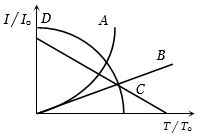
The ratio of thermionic currents $(I/I0)$ for a metal when the temperature is slowly increased ${T_0}$ to $T$ as shown in figure. ($I$ and $I_0$ are currents at $T$ and $T_0$  respectively). Then which one is correct?
$A$ wall is made up of two layers $A$ and $B$ . The thickness of the two layers is the same, but materials are different. The thermal conductivity of $A$ is double than that of $B$ . In thermal equilibrium the temperature difference between the two ends is ${36^o}C$. Then the difference of temperature at the two surfaces of $A$ will be ....... $^oC$
A tunnel is dug across the diameter of earth $A$ ball is released from the surface of  Earth into the tunnel. The velocity of ball when it is at a distance $\frac{R}{2}$ from  centre of earth is (where $R$ = radius of Earth and $M$ = mass of Earth)
How much length of a very thin wire is required to obtain a solenoid of length ${l_0}$ and inductance $L$
One end of a long metallic wire of length $L$ is tied to the ceiling. The other end is tied to massless spring of spring constant $K$. A mass $ m$ hangs freely from the free end of the spring. The area of cross-section and Young's modulus of the wire are $A$ and $Y$ respectively. If the mass is slightly pulled down and released, it will oscillate with a time period $T$ equal to
Suppose the drift velocity $v_d$ in a material varied with the applied electric field $E$ as ${v_d}\, \propto \,\sqrt E $ .Then $V - I$ graph for a wire made of such a material is best given by
In a vessel equal masses of alcohol (sp. gravity $0.8$ ) and water are mixed together. A capillary tube of radius $1\,mm$ is dipped vertically in it. If the mixture rises to a height $5\,cm$ in the capillary tube, the surface tension of the mixture is ....... $dyne/cm$
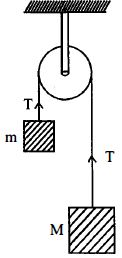
Two blocks of masses $m$ and $M$ are connected by means of a metal wire of cross-sectional area $A$ passing over a frictionless fixed pulley as shown in the figure. The system is then released. If $M = 2\, m$, then the stress produced in the wire is
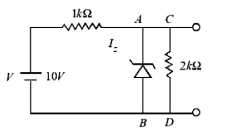
In the given circuit, the breakdown voltage of the Zener diode is $3.0 \mathrm{~V}$. What is the value of $\mathrm{I}_z$ ?