MCQ
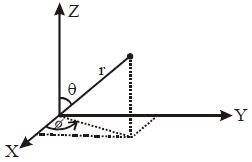
Angular wave function $A(\theta , \phi )$ for any atomic orbital is " $\frac{1}{2}\sqrt {\frac{3}{\pi }\cos \theta }$ " in polar co-ordinate system
  • A
    $2s$
  • B
    $2P_x$
  • C
    $2P_y$
  • $2P_Z$

Answer

Correct option: D.
$2P_Z$
d
For $P_Z4$ orbital nodal plane is $XY$ plane  i.e. $cos\, 90^o = 0$

Need a full question paper?

Generate a complete, print-ready paper with questions like this in minutes — across 16+ boards, with answer keys.

Start Generating Free

Similar questions

$N{a_2}{B_4}{O_7}\xrightarrow{x}{H_3}B{O_3}\xrightarrow{\Delta }{B_2}{O_3}\xrightarrow{y}B$

Here $X, Y$ are respectively

In which of the following compounds the oxidation number of carbon is maximum
A similarity between optical and geometrical isomerism is that
A $0.1\, M$ solution of $HF$ is $1\%$ ionized. What is the $K_a$
Which equilibrium can be described as an acid-base reaction using the Lewis acid-base definition but not using the Bronsted-Lowry definition
Which of the following is least reactive towards electrophilic substitution
Which is the most suitable reagent among the following to distinguish compound $(3)$ from rest of the compounds ?

$1.\,\,CH_3-C  \equiv  C -CH_3$

$2.\,\,CH_3 - CH_2 - CH_2 - CH_3$

$3. \,\,CH_3 - CH_2C  \equiv CH$

$4.\,\,CH_3 - CH = CH_2$
The correct sequence of reagents used in the preparation of $4 -$bromo$-2-$nitroethyl benzene from benzene is :
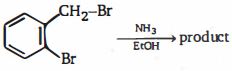
What is the major product obtained in the following reaction ?
Given below are two statements: one is labelled as Assertion $(A)$ : and the other is labelled as Reason $(R)$. Assertion $(A)$ : Both rhombic and monoclinic sulphur exist as $S_5$ while oxygen exists as $O_2$.

Reason $(R)$ : Oxygen forms $\mathrm{p} \pi-\mathrm{p} \pi$ multiple bonds with itself and other elements having small size and high electronegativity like $\mathrm{C}, \mathrm{N}$, which is not possible for sulphur.

In the light of the above statements, choose the most appropriate answer from the options given below :