MCQ
Angular width of central maxima in the Fraunhoffer diffraction pattern of a slit is measured. The slit is illuminated by light of wavelength 6000 Å. When the slit is illuminated by light of another wavelength, the angular width decreases by 30%. The wavelength of this light will be
  • A
    6000 Å
  • 4200 Å
  • C
    3000 Å
  • D
    1800 Å

Answer

Correct option: B.
4200 Å
4200 Å

Need a full question paper?

Generate a complete, print-ready paper with questions like this in minutes — across 16+ boards, with answer keys.

Start Generating Free

Similar questions

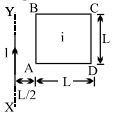
A square loop $ABCD$, carrying a current $i,$ is placed near and coplanar with a long straight conductor $XY$ carrying a current $I,$ the net force on the loop will be
If two conducting spheres are separately charged and then brought in contact
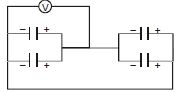
The four capacitors, each of $25\,\mu \,F$ are connected as shown in fig. The $dc$ voltmeter reads $200\,V$. The charge on each plate of capacitor is
Two identical coaxial circular loops carry a current $i$ each circulating in the same direction. If the loops approach each other
A molecule of a substance has permanent dipole moment $p$. A mole of this substance is polarised by applying a strong electrostatic field $E$. The direction of the field is suddenly changed by an angle of $60^{\circ} .$ If $N$ is the Avogadro's number the amount of work done by the field is
The speed of an electron having a wavelength of ${10^{ - 10}}m$ is ................. $ \times {10^6}\,m/s$
The work functions of Silver and Sodium are $4.6$ and $2.3 \ eV$, respectively. The ratio of the slope of the stopping potential versus frequency plot for Silver to that of Sodium is :
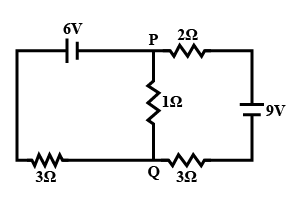
In the circuit shown, the current in the $1\,\Omega$ resistor is
Assertion : There exists two angles of incidence for the same magnitude of deviation (except minimum deviation) by a prism kept in air.

Reason : In a prism kept in air, a ray is incident on first surface and emerges out of second surface. Now if another ray is incident on second surface (of prism) along the previous emergent ray, then this ray emerges out of first surface along the previous incident ray. This particle is called principle of reversibility of light.

A metal rod of length $2\,m$ is rotating with an angular velocity of $100\, rad/sec$  in a plane perpendicular to a uniform magnetic field of $0.3 \,T$. The potential difference between the ends of the rod is.......$V$