MCQ
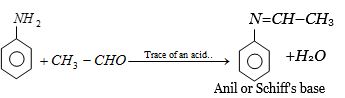
Aniline reacts with acetaldehyde to form
  • Schiff's base
  • B
    Carbylamine
  • C
    Immine
  • D
    None of these

Answer

Correct option: A.
Schiff's base
a
(a)

Need a full question paper?

Generate a complete, print-ready paper with questions like this in minutes — across 16+ boards, with answer keys.

Start Generating Free

Similar questions

On electrolysis of aqueous solution of $KI$ in presence of platinum electrodes 
$(a)$ Hydrogen gas is released at cathode
$(b)$ Oxygen gas is released at anode
$(c)$ $pOH$ of solution decreases
$(d)$ There is deposition of potassium at cathode
Choose the correct option from following
The reaction conditions leading to the best yield of $\mathrm{C}_2 \mathrm{H}_5 \mathrm{Cl}$ are:
$SbF_5$ reacts with $XeF_4$ to form an adduct. The shapes of cation and anion in the adduct are respectively:
For the following reaction, yield of product is highest in :
$CH_3-Br + NaOH \to CH_3-OH + NaBr$
At $298\, K$, the standard electrode potentials of $Cu ^{2+} /$ $Cu , Zn ^{2+} / Zn , Fe ^{2+} / Fe$ and $Ag ^{+} / Ag$ are $0.34\, V$, $-0.76\, V ,-0.44\, V$ and $0.80\, V$, respectively.

On the basis of standard electrode potential, predict which of the following reaction can not occur ?

If $‘a’ $ is the initial concentration and $ ‘n’ $ is the order of the reaction and the half life period is $ ‘T’,$  then
Hydrolysis of which of the following does not occur
The molar conductance of $\mathrm{NaCl}, \mathrm{HCl}$ and $\mathrm{CH}_{3} COONa$ at infinite dilution are $126.45,426.16$ and $91.0\, \mathrm{~S} \,\mathrm{~cm}^{2} \,\mathrm{~mol}^{-1}$ respectively. The molar conductance of $\mathrm{CH}_{3} \mathrm{COOH}$ at infinite dilution is. Choose the right option for your answer. (In $\mathrm{~S} \mathrm{~cm}^{2} \mathrm{~mol}^{-1}$)
The reaction $2NO + Br_2 \rightarrow  2NOBr,$ follows the mechanism given below

$(I)$  $NO + Br_2 \rightleftharpoons  NOBr_2 $    ........ Fast

$(II)$  $NOBr_2 + NO \rightarrow 2NOBr$     ......... Slow

The overall order of this reaction is

Non-occurence of the following reaction

$Br^-+ CH_3OH \rightarrow BrCH_3 + OH^-,$ is due to