MCQ
Aniline reacts with acetaldehyde to form
  • Schiff's base
  • B
    Carbylamine
  • C
    Immine
  • D
    None of these

Answer

Correct option: A.
Schiff's base
a
${C_6}{H_5} - N{H_2} + C{H_3} - CHO\xrightarrow{{{H^ + }}}\mathop {C{H_3} - CH = N - {C_6}{H_5}}\limits_{{\text{Schiff's base}}} $

Need a full question paper?

Generate a complete, print-ready paper with questions like this in minutes — across 16+ boards, with answer keys.
Start Generating Free

Similar questions

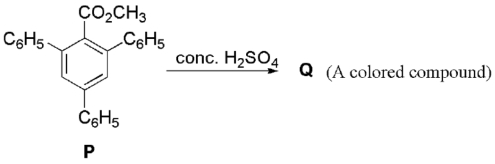
In the following reaction, compound $Q$ is obtained from compound $P$ via an ionic intermediate What is the degree of unsaturation of $Q$ ?
Which reaction results in the formation of a pair of enantiomers ?
An example of water soluble vitamin is:
Consider the following reaction

$\mathrm{MnO}_2+\mathrm{KOH}+\mathrm{O}_2 \rightarrow \mathrm{A}+\mathrm{H}_2 \mathrm{O} .$

Product ' $A$ ' in neutral or acidic medium disproportionate to give products ' $\mathrm{B}$ ' and ' $\mathrm{C}$ ' along with water. The sum of spin-only magnetic moment values of $B$ and $C$ is . . . . . .$BM$. (nearest integer)

(Given atomic number of $\mathrm{Mn}$ is $25$ )

Calculate the standard cell potential (in $V$) of the cell in which following reaction takes place

$F{e^2}+ \left( {aq} \right) + A{g^ + }\left( {aq} \right) \to F{e^{3 + }}\left( {aq} \right) + Ag\left( s \right)$

Given that:
$E_{Ag^+/Ag}^o = xV$
$E_{F{e^{2 + }}/Fe}^o = yV$
$E_{F{e^{3 + }}/Fe}^o = zV$
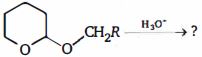
Which of following does not react with $NaHSO_3$ (sodium bisulphite)?
An ester $(A)$ with molecular fomula, $C_9H_{10}O_2$ was treated with excess of $CH_3MgBr$ and the complex so formed was treated with $H_2SO_4$ to give an olefin $(B)$. Ozonolysis of $(B)$ gave a ketone with molecular formula $C_8H_8O$ which shows positive iodoform test. The structure of $(A)$ is
Each of the following is true for white and red phosphorus except that they
The reagent that can distinguish benzaldehyde from propionaldehyde is
The major product formed in the reaction is