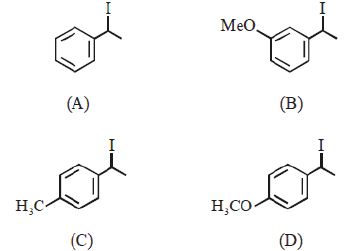
MCQ
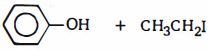
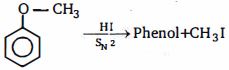
Anisole $\frac{excess\, HI \,(conc.)}{reflux}$ Product
- A
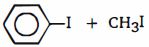
- B
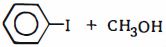
- ✓
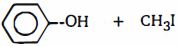
- D
Generate a complete, print-ready paper with questions like this in minutes — across 16+ boards, with answer keys.
$(i)$ $\begin{gathered}
HCN\left( {aq} \right) + {H_2}O\left( l \right) \rightleftharpoons {H_3}{O^ + }\left( {aq} \right) + C{N^ - }\left( {aq} \right) \hfill \\
{K_a} = 6.2 \times {10^{ - 10}} \hfill \\
\end{gathered} $
$(ii)$ $\begin{gathered}
C{N^ - }\left( {aq} \right) + {H_2}O\left( l \right) \rightleftharpoons HCN\left( {aq} \right) + O{H^ - }\left( {aq} \right) \hfill \\
{K_b} = 1.6 \times {10^{ - 5}} \hfill \\
\end{gathered} $
These equilibria show the following order of the relative base strength
phenol $\xrightarrow[{reaction}]{{\operatorname{Re} imer - Tiemann}}X\xrightarrow[{(ii)\,{H^ \oplus }}]{{(i)\,NaOH\,conc}}Z$
Product $Z$ is
$(i)\,\,$on doubling the initial concentration of $A$ only, the rate of reaction is also doubled and
$(ii)$ on doubling the initial concentration of both $A$ and $B,$ there is a change by a factor of $8$ in the rate of the reaction.
The rate of this reaction is given by