Question
Answer in brief:
Explain the spectral distribution of blackbody radiation.
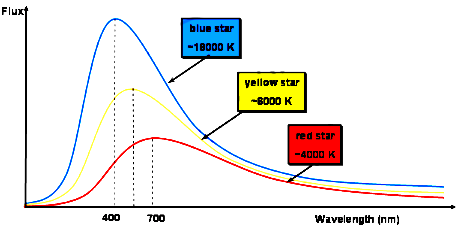
Answer

All objects with a temperature above absolute zero $(0 K$, $-273.15^{\circ} C$ ) emit energy in the form of electromagnetic radiation.
A blackbody is a theoretical or model body that absorbs all radiation falling on it, reflecting or transmitting none. It is a hypothetical object which is a "perfect" absorber and a "perfect" emitter of radiation over all wavelengths.
The spectral distribution of the thermal energy radiated by a blackbody (i.e. the pattern of the intensity of the radiation over a range of wavelengths or frequencies) depends only on its temperature

The characteristics of blackbody radiation can be described in terms of several laws:
1. Planck's Law of blackbody radiation, a formula to determine the spectral energy density of the emission at each wavelength $\left(E_\lambda\right)$ at a particular absolute temperature (T).
$
E _\lambda=\frac{8 \pi h c }{\lambda^5\left( e ^{ hc / \lambda kT }-1\right)}
$
2. Wien's Displacement Law, which states that the frequency of the peak of the emission $\left(f_{\max }\right)$ increases linearly with absolute temperature ( $T$ ). Conversely, as the temperature of the body increases, the wavelength at the emission peak decreases.
$
f _{\max } \propto T
$
3. Stefan-Boltzmann Law, which relates the total energy emitted (E) to the absolute temperature (T).
$
E \propto T ^4
$
In the image above, notice that:
- The blackbody radiation curves have quite a complex shape (described by Planck's Law).
- The spectral profile (or curve) at a specific temperature corresponds to a specific peak wavelength, and vice versa.
- As the temperature of the blackbody increases, the peak wavelength decreases (Wien's Law).
- The intensity (or flux) at all wavelengths increases as the temperature of the blackbody increases.
- The total energy being radiated (the area under the curve) increases rapidly as the temperature increases (StefanBoltzmann Law).
- Although the intensity may be very low at very short or long wavelengths, at any temperature above absolute zero energy is theoretically emitted at all wavelengths (the blackbody radiation curves never reach zero).

Need a full question paper?

Generate a complete, print-ready paper with questions like this in minutes — across 16+ boards, with answer keys.

Start Generating Free

Similar questions

Explain the magnetic dipole moment of a current loop. State its magnitude and direction.
A $100 V$ battery is connected across the combination of capacitors of capacities $4 \mu F$ and $8 \mu F$ in parallel and then in series. Calculate the charge on each capacitor in parallel and in series combination.
The threshold wavelength of tungsten is $2.76 \times 10^{-5} cm$. (a) Explain why no photoelectrons are emitted when the wavelength is more than $2.76 \times 10^{-5} cm$.(b) What will be the maximum kinetic energy of electrons ejected in each of the following cases
(i) if ultraviolet radiation of wavelength $\lambda=1.80 \times 10^{-5} cm$ and
(ii) radiation of frequency $4 \times 10^{15} Hz$ is made incident on the tungsten surface.
Sodium light of wavelength $5.896 \times 10^{-7} m$ is passed through two pinholes $0.5 mm$ apart, and an interference pattern is formed on a screen kept parallel to the plane of the pinholes and $1.2 m$ from them. Find the distance between
$(i)$ the second and the fifth bright fringes
$(ii)$ the third and the seventh dark fringes on the same side of the central bright point.
What is the electric potential at the centre of a square of side $1 m$ if point charges $1 \times 10^{-8} C$, $-2 \times 10^{-8} C , 3 \times 10^{-8} C$ and $2 \times 10^{-8} C$ are placed at the corners of the square?
State the postulates of Bohr’s atomic model. Hence show the energy of electrons varies inversely to the square of the principal quantum number.
A circular disc of moment of inertia $10 \mathrm{~kg} \cdot \mathrm{m}^2$ is rotated about its transverse symmetry axis at a constant frequency of $60 \mathrm{rpm}$ by an electric motor of power 31.42 watts. When the motor is switched off, how many rotations does it complete before coming to rest?
The pth overtone of an organ pipe open at both ends has a frequency $n$. When one end of the pipe is closed, the qth overtone has a frequency $N$. Show that $N =\frac{(2 q+1) n}{2(p+1)}$.
Show that a linear $S.H.M$. is the projection of a $U.C.M$. along any of its diameter.
State and explain Prevost's theory of exchange of heat.