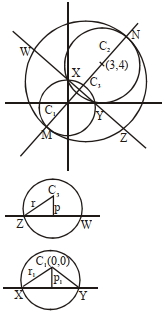
MCQ
Answer the following by appropriately matching the lists based on the information given in the paragraphLet the circles $C_1: x^2+y^2=9$ and $C_2:(x-3)^2+(y-4)^2=16$, intersect at the points $X$ and $Y$. Suppose that another circle $C_3:(x-h)^2+(y-k)^2=r^2$ satisfies the following conditions :
$(i)$ centre of $C _3$ is collinear with the centres of $C _1$ and $C _2$
$(ii) \ C _1$ and $C _2$ both lie inside $C _3$, and
$(iii) \ C _3$ touches $C _1$ at $M$ and $C _2$ at $N$.
Let the line through $X$ and $Y$ intersect $C _3$ at $Z$ and $W$, and let a common tangent of $C _1$ and $C _3$ be a tangent to the parabola $x^2=8 \alpha y$.
There are some expression given in the List$-I$ whose values are given in List$-II$ below:
List$-I$ List$-II$
$(I) \ 2 h + k$ $(P) \ 6$
$(II) \ \frac{\text { Length of } ZW }{\text { Length of } XY }$ $(Q) \ \sqrt{6}$
$(III) \ \frac{\text { Area of triangle } MZN }{\text { Area of triangle ZMW }}$ $(R) \ \frac{5}{4}$
$(IV) \ \alpha$ $(S) \ \frac{21}{5}$
  $(T) \ 2 \sqrt{6}$
  $(U) \ \frac{10}{3}$
$(1)$ Which of the following is the only $\text{INCORRECT}$ combination?
$(1) (IV), (S) \ (2) (IV), (U) \ (3) (III), (R) \ (4) (I), (P)$
$(2)$ Which of the following is the only $\text{CORRECT}$ combination?
$(1) (II), (T) \ (2) (I), (S) \ (3) (I), (U) \ (4) (II), (Q)$
Give the answer or quetion ($1$) and ($2$)
  • $1,4$
  • B
    $1,3$
  • C
    $1,2$
  • D
    $2,4$

Answer

Correct option: A.
$1,4$
$($image$)MC _1+ C _1 C _2+ C _2 N =2 r$
$\Rightarrow 3+5+4=2 r$
$\Rightarrow r =6$
$\Rightarrow$ Radius of $C _3=6$
Suppose centre of $C_3$ be $\left(0+r_4 \cos \theta, 0+r_4 \sin \theta\right),\left\{\begin{array}{l}r_4=C_1 C_3=3 \\ \tan \theta=\frac{4}{3}\end{array}\right\}$
$C _3=\left(\frac{9}{5}, \frac{12}{5}\right)=( h , k )$
$\Rightarrow 2 h + k =6$
Equation of $ZW$ and $XY$ is $3 x +4 y -9=0$
$($common chord of circle $C _1=0$ and $C _2=0)$
$ZW =2 \sqrt{ r ^2- p ^2}=\frac{24 \sqrt{6}}{5} ($where $r =6$ and $p =\frac{6}{5})$
$($image$)$
$XY =2 \sqrt{ r _1^2- p _1^2}=\frac{24}{5} ($where $r _1=3$ and $p _1=\frac{9}{5})$
$($image$)$
$\frac{\text { Length of } ZW }{\text { Length of } XY }=\sqrt{6}$
Let length of perpendicular from $M$ to $ZW$ be $\lambda, \lambda=3+\frac{9}{5}=\frac{24}{5}$
$\frac{\text { Area of } \triangle MZN }{\text { Area of } \triangle ZMW }=\frac{\frac{1}{2}( MN ) \times \frac{1}{2}( ZW )}{\frac{1}{2} \times ZW \times \lambda}=\frac{1}{2} \frac{ MN }{\lambda}=\frac{5}{4}$
$C_3:\left(x-\frac{9}{5}\right)^2+\left(y-\frac{12}{5}\right)^2=6^2$
$C_1: x^2+y^2-9=0$
common tangent to $C _1$ and $C _3$ is common chord of $C _1$ and $C _3$ is $3 x +4 y +15=0$.
Now $3 x+4 y+15=0$ is tangent to parabola $x^2=8 \alpha y$.
$x^2=8 \alpha\left(\frac{-3 x -15}{4}\right)$
$\Rightarrow 4 x ^2+24 \alpha x +120 \alpha=0$
$D =0$
$\Rightarrow \alpha=\frac{10}{3}$

Need a full question paper?

Generate a complete, print-ready paper with questions like this in minutes — across 16+ boards, with answer keys.

Start Generating Free

Similar questions

If the length of the perpendicular from the point $(\beta , 0, \beta )\, (\beta  \neq 0)$ to the line $\frac{x}{1} = \frac{{y - 1}}{0} = \frac{{z + 1}}{{ - 1}}$ is $\sqrt {\frac{3}{2}} $, then $\beta $ is equal to
If $A + B + C = \frac{{3\pi }}{2},$ then $\cos 2A + \cos 2B + \cos 2C = $
If the system of equations

$ 2 x+7 y+\lambda z=3 $

$ 3 x+2 y+5 z=4 $

$ x+\mu y+32 z=-1$

has infinitely many solutions, then $(\lambda-\mu)$ is equal to $\qquad$

The set of all values of $ ' a '$ for which the function , $f (x) = (a^2 - 3 a + 2) \left( {{{\cos }^{2\,}}\,\frac{x}{4}\,\, - \,\,{{\sin }^2}\,\,\frac{x}{4}} \right) + (a - 1) x + sin \,1 $ does not possess critical points is
If ${z_1} = 1 + 2i$ and ${z_2} = 3 + 5i$, and then $\operatorname{Re} \left( {\frac{{{{\bar z}_2}{z_1}}}{{{z_2}}}} \right)$ is equal to
For all $z \in C$ on the curve $C _1:| z |=4$, let the locus of the point $z +\frac{1}{ z }$ be the curve $C _2$. Then
$A$ and $B$ are two events such that $P (A)= 0.8, P(B)=0.6$ and $P(A \cap B) = 0.5,$ then the value of $P\,(A/B)$ is
${\cot ^{ - 1}}\left[ {\frac{{\sqrt {1 - \sin x} + \sqrt {1 + \sin x} }}{{\sqrt {1 - \sin x} - \sqrt {1 + \sin x} }}} \right] = $
If in triangle $ABC$ ,$ A \equiv (1, 10) $, circumcentre $\equiv$ $\left( { - \,\,{\textstyle{1 \over 3}}\,\,,\,\,{\textstyle{2 \over 3}}} \right)$ and orthocentre $\equiv$ $\left( {{\textstyle{{11} \over 3}}\,\,,\,\,{\textstyle{4 \over 3}}} \right)$ then the co-ordinates of mid-point of side opposite to $A$ is :