MCQ
Answer the following by appropriately matching the lists based on the information given in the paragraph.

A musical instrument is made using four different metal strings, $1,2,3$ and $4$ with mass per unit length $\mu, 2 \mu, 3 \mu$ and $4 \mu$ respectively. The instrument is played by vibrating the strings by varying the free length in between the range $L _0$ and $2 L _0$. It is found that in string-$1$ $(\mu)$ at free length $L _0$ and tension $T _0$ the fundamental mode frequency is $f _0$.

$List-I$ gives the above four strings while $list-II$ lists the magnitude of some quantity.

$List-I$ $List-II$
$(I)$ String-1( $\mu$ ) $(P) 1$
$(II)$ String-2 $(2 \mu)$ $(Q)$ $1 / 2$
$(III)$ String-3 $(3 \mu)$ $(R)$ $1 / \sqrt{2}$
$(IV)$ String-4 $(4 \mu)$ $(S)$ $1 / \sqrt{3}$
  $(T)$ $3 / 16$
  $(U)$ $1 / 16$

($1$) If the tension in each string is $T _0$, the correct match for the highest fundamental frequency in $f _0$ units will be,

$(1)$ $I \rightarrow P , II \rightarrow R , III \rightarrow S , IV \rightarrow Q$

$(2)$ $I \rightarrow P , II \rightarrow Q , III \rightarrow T , IV \rightarrow S$

$(3)$ $I \rightarrow Q , II \rightarrow S , III \rightarrow R , IV \rightarrow P$

$(4)$ I $\rightarrow Q , II \rightarrow P , III \rightarrow R$, IV $\rightarrow T$

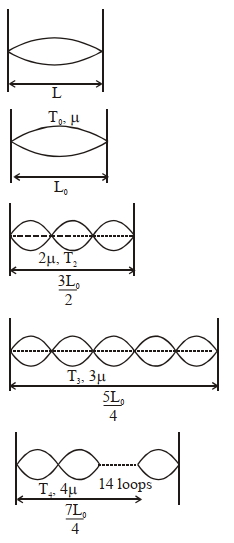
($2$) The length of the string $1,2,3$ and 4 are kept fixed at $L _0, \frac{3 L _0}{2}, \frac{5 L _0}{4}$ and $\frac{7 L _0}{4}$, respectively. Strings $1,2,3$ and 4 are vibrated at their $1^{\text {tt }}, 3^{\text {rd }}, 5^{\text {m }}$ and $14^{\star}$ harmonics, respectively such that all the strings have same frequency. The correct match for the tension in the four strings in the units of $T _0$ will be.

$(1)$ $I \rightarrow P , II \rightarrow Q , III \rightarrow T , IV \rightarrow U$

$(2)$ $I \rightarrow T , II \rightarrow Q , III \rightarrow R$, IV $\rightarrow U$

$(3)$ $I \rightarrow P , II \rightarrow Q , III \rightarrow R , IV \rightarrow T$

$(4)$ I $\rightarrow P , II \rightarrow R , III \rightarrow T , IV \rightarrow U$

  • A
    $1,2$
  • B
    $1,3$
  • $1,1$
  • D
    $1,4$

Answer

Correct option: C.
$1,1$
c
For fundamental mode

(image)

$f =\frac{ V }{\lambda}=\frac{1}{2 L } \sqrt{\frac{ T }{\mu}}$

For string $(1)$

$f_0=\frac{1}{2 L} \sqrt{\frac{T}{\mu}} \Rightarrow(P)$

For string $(2)$

$f =\frac{1}{2 L } \sqrt{\frac{ T }{2 \mu}}=\frac{ f _0}{\sqrt{2}} \Rightarrow( R )$

For string $(3)$

$f =\frac{1}{2 L } \sqrt{\frac{ T }{3 \mu}}=\frac{ f _0}{\sqrt{3}} \Rightarrow( S )$

For string $(4)$

$f=\frac{1}{2 L} \sqrt{\frac{T}{4 \mu}}=\frac{f_0}{2} \Rightarrow(Q)$

($2$) For string $(1)$

Length of string $= L _0$

It is vibrating in $I ^{ ts }$ harmonic i.e. fundamental mode.

(image)

$f _0=\frac{1}{2 L _0} \sqrt{\frac{ T _0}{\mu}} \Rightarrow( P )$

For string $(2)$

Length of string $=\frac{3 L _0}{2}$

It is vibrating in $III ^{\text {rd }}$ harmonic but frequency is still $f _0$.

$f_0=\frac{3 v}{2 L}$

(image)

$f _0=\frac{3}{2\left(\frac{3 L _0}{2}\right)} \sqrt{\frac{ T _2}{2 \mu}}$

$\Rightarrow f _0=\frac{1}{ L _0} \sqrt{\frac{ T _2}{2 \mu}}=\frac{1}{2 L _0} \sqrt{\frac{ T _0}{\mu}}$

$\Rightarrow T _2=\frac{ T _0}{2} \Rightarrow \text { (Q) }$

For string $(3)$

Length of string $=\frac{5 L _0}{4}$

It is vibrating in $5^{\text {th }}$ harmonic but frequency is still $f _0$.

$f _0=\frac{5 V }{2 L }$

(image)

$\Rightarrow f _0=\frac{5}{2\left(\frac{5 L _0}{4}\right)} \sqrt{\frac{ T _3}{3 \mu}}=\frac{1}{2 L _0} \sqrt{\frac{ T _0}{\mu}}$

$\Rightarrow \frac{2}{ L _0} \sqrt{\frac{ T _3}{3 \mu}}=\frac{1}{2 L _0} \sqrt{\frac{ T _0}{\mu}}$

$T _3=\frac{3 T _0}{16} \Rightarrow( T )$

For string $(4)$

Length of string $=\frac{7 L _0}{4}$

It is vibrating in $14^{\text {th }}$ harmonic but frequency is still $f _0$.

(image)

$f _0=\frac{14 v }{2 L }$

$\begin{array}{l}\Rightarrow \quad f _0=\frac{14}{2\left(\frac{7 L _0}{4}\right)} \sqrt{\frac{ T _4}{4 \mu}}=\frac{1}{2 L _0} \sqrt{\frac{ T _0}{\mu}} \\ \Rightarrow \frac{4}{ L _0} \sqrt{\frac{ T _4}{4 \mu}}=\frac{1}{2 L _0} \sqrt{\frac{ T _0}{\mu}} \Rightarrow T _4=\frac{ T _0}{16} \Rightarrow( U ) \\\end{array}$

Need a full question paper?

Generate a complete, print-ready paper with questions like this in minutes — across 16+ boards, with answer keys.

Start Generating Free

Similar questions

Which of the following pairs has quantities of the same dimensions?
  1. Magnetic field $B$ and magnetizing field intensity $H.$
  2. Magnetic field $B$ and intensity of magnetization $I.$
  3. Magnetizing field intensity $H$ and intensity of magnetization $I.$
  4. Longitudinal strain and magnetic susceptibility.
An object is subjected to a force in the north-east direction. To balance this force, a second force should be applied in the direction
The figure shows a velocity-time graph of a particle moving along a straight line  The correct acceleration-time graph of the particle is shown as
lfa simple pendulum has significant amplitude (up to a factor of $1/e$ of original) only in the period between $t = 0\ s$ to $t = \tau \ s$, then $\tau$ may be called the average life of the pendulum. When the spherical bob of the pendulum suffers a retardation ( due to viscous drag) proportional to its velocity with $b$ as the constant of proportionality, the average life time of the pendulum is (assuming damping is small) in seconds
What is the velocity of the bob of a simple pendulum at its mean position, if it is able to rise to vertical height of $10\,cm$ ($g = 9.8\, m/s^2$) ..... $m/s$
If position time graph of a particle is sine curve as shown, what will be its velocity-time graph.
A student performs an experiment of measuring the thickness of a slab with a vernier calliper whose $50$ divisions of the vernier scale are equal to $49$ divisions of the main scale. He noted that zero of the vernier scale is between $7.00\; cm$ and $7.05 \;cm$ mark of the main scale and $23^rd$ division of the vernier scale exactly coincides with the main scale. The measured value of the thickness of the given slab using the calliper will be
The three vessels shown in fisure $(13- Q2)$ have same base area. Equal volumes of a liquid are poured in the three vessels. The force on the base will be:
 
A tangential force $F$ is applied on a disc of radius $R$, due to which it deflects through an angle $\theta $ from its initial position. The work done by this force would be
Consider the following two equations:
$A. \text{L}=\text{I}\omega$
$B. \frac{\text{dL}}{\text{dt}}=\Gamma$
In noninertial frames: