MCQ
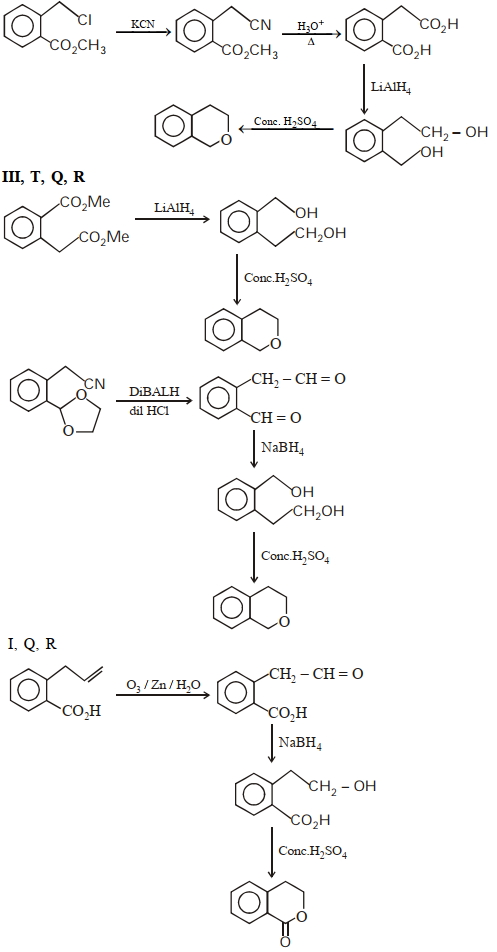
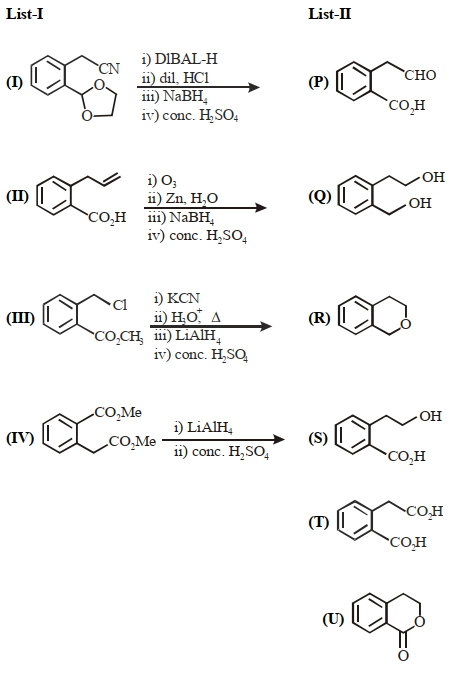
Answer the following by appropriately matching the lists based on the information given in the paragraph $List-I$ includess starting materials and reagents of selected chemical reactions. $List-II$ gives structures of compounds that may be formed as intermediate products and/or final products from the reactions of $List-I$

($1$) Which of the following options has correct combination considering $List-I$ and $List-II$?

$(1) (III), (S), (R)$ $(2) (IV), (Q), (R)$ $(3) (III), (T), (U)$ $(4) (IV), (Q), (U)$

($2$) Which of the following options has correct combination considering $List-I$ and $List-II$?

$(1) (I), (Q), (T), (U)$ $(2) (II), (P), (S), (U)$ $(3) (II), (P), (S), (T)$ $(4) (I), (S), (Q), (R)$

Give the answer quetion ($1$) and ($2$)
  • A
    $1,2$
  • B
    $1,3$
  • $2,2$
  • D
    $2,4$

Answer

Correct option: C.
$2,2$
c

Need a full question paper?

Generate a complete, print-ready paper with questions like this in minutes — across 16+ boards, with answer keys.

Start Generating Free

Similar questions

In the reaction sequence $2C{H_3}CHO\xrightarrow{{O{H^ - }}}A\xrightarrow{\Delta }B$ ; the product $B$ is
Given below are two statements:

Statement $(I)$ : Fusion of $\mathrm{MnO}_2$ with $\mathrm{KOH}$ and an oxidising agent gives dark green $\mathrm{K}_2 \mathrm{MnO}_4$.

Statement $(II)$ : Manganate ion on electrolytic oxidation in alkaline medium gives permanganate ion.

In the light of the above statements, choose the correct answer from the options given below.

Assertion : Sulphuric acid is more viscous than water.

Reason : Concentrated sulpuric acid has a great affinity for water.

The higher concentration of which gas in air can cause stiffness of flower buds?
Which one of the following bases is not present in $DNA$ ?
Which among the following reaction will take place spontaneously
The electronic configuration for Neodymium is: [Atomic Number for Neodymium $60$]
Among the following compounds, which on heating do not produce $N_2$ ?
Given the molecular formula of the hexa coordinated complexes (a) $CoC{l_3}.6N{H_3}$ (b)$CoC{l_3}.5N{H_3}$ (c)$CoC{l_3}.4N{H_3}$. If the number of co-ordinated $N{H_3}$ molecules in $A, B $ and $C$  respectively are $6, 5$  and $ 4, $ the primary valency in $ (a), (b)$ and $(c) $ are:
Starting from propanoic acid the following reactions were carried out as following $CH_3 - CH_2 - COOH$ $\xrightarrow{{SOC{l_2}}}\left[ X \right]\xrightarrow[\Delta ]{{N{H_3}}}\left[ Y \right]\xrightarrow[{KOH}]{{B{r_2}}}\left[ Z \right]$ Product $[Z]$ will be?