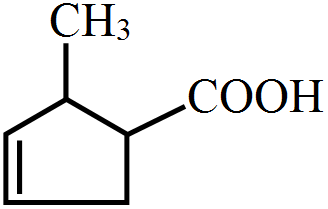
Question
Answer the following question:
Complete the following chemical equations:
  1. $\text{P}_4+\text{SO}_2\text{Cl}_2\rightarrow$
  2. $\text{XeF}_2+\text{H}_2\text{O}\rightarrow$
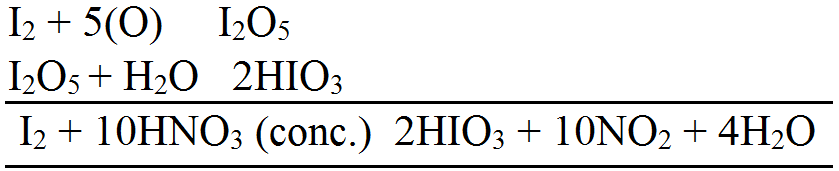
  3. $\text{I}_2+\text{HNO}_3\rightarrow\\ \ \ \ \ \ \ \ \ \ ^\text{(cone)}$
Answer

  1. $\text{P}_4+10\text{SO}_2\text{Cl}_2\rightarrow4\text{PCl}_5+10\text{SO}_2$
  2. $2\text{XeF}_2+2\text{H}_2\text{O}\rightarrow2\text{Xe}+4\text{HF}+\text{O}_2$
  3. $2\text{HNO}_3(\text{conc.})\rightarrow\text{H}_2\text{O}+2\text{NO}_2+\text{(O)}]\times5$
​​​​​​​

Need a full question paper?

Generate a complete, print-ready paper with questions like this in minutes — across 16+ boards, with answer keys.

Start Generating Free

Similar questions

Write the monomers used for getting the following polymers:
  1. Polyvinyl chloride.
  2. Teflon.
  3. Bakelite.
The electrical resistance of a column of $0.05 M$ KOH solution of diameter $1 cm$ and length $45·5 cm$ is $4.55 \times$ $10^3$ ohm. Calculate its molar conductivity.
Explain the structure and function of salt bridge of molten galvanic cell.
What is the significance of leaching in the extraction of aluminium?
Illustrate how copper and zinc give different products on reaction with $HNO_3.$
How will you distinguish between the following pairs of compounds:
Benzyl chloride and chlorobenzene.

Give the IUPAC name of the following organic compounds:
  1. $\text{(CH}_3)_2\text{C}=\text{CH}-\text{C}-\text{CH}_3\\ \ \ \ \ \ \ \ \ \ \ \ \ \ \ \ \ \ \ \ \ \ \ \ \ \ \ \ \ \ \ \ \ ||\\ \ \ \ \ \ \ \ \ \ \ \ \ \ \ \ \ \ \ \ \ \ \ \ \ \ \ \ \ \ \ \ \ \text{O}$
  2.  
  1. $\text{CH}_3\text{CH}\text{(Br)}\text{CH}_2\text{CONHCH}_3$
Write one difference in each of the following:
  1. Multimolecular colloid and Associated colloid.
  2. Coagulation and Peptization.
  3. Homogeneous catalysis and Heterogeneous catalysis.
i. What type of isomerism is shown by the complex $\left[\mathrm{Co}\left(\mathrm{NH}_3\right)_6\right]\left[\mathrm{Cr}(\mathrm{CN})_6\right]$ ?
ii. Why a solution of $\left[\mathrm{Ni}\left(\mathrm{H}_2 \mathrm{O}\right)_6\right]^{2+}$ is green while a solution of $\left[\mathrm{Ni}(\mathrm{CN})_4\right]^{2-}$ is colourless? (At. no. of $\mathrm{Ni}=28$ )
iii. Write the IUPAC name of the following complex: $\left[\mathrm{Co}\left(\mathrm{NH}_3\right)_5\left(\mathrm{CO}_3\right)\right] \mathrm{Cl}$.
Write the role of
  1. $I_2$ in the van Arkel method of refining.
  2. Cryolite in the extraction of aluminium.
  3. Dilute NaCN in the extraction of silver.