Question
Answer the following question:
Long distance radio broadcasts use short-wave bands. Why?

Answer

Long distance radio broadcasts use shortwave bands because only these bands can be refracted by the ionosphere.

Need a full question paper?

Generate a complete, print-ready paper with questions like this in minutes — across 16+ boards, with answer keys.
Start Generating Free

Similar questions

Which one of the following cannot emit radiation and why? Excited nucleus, excited electron.
Suppose all the electrons of 100g water are lumped together to form a negatively charged particle and all the nuclei are lumped together to form a positively charged particle. If these two particles are placed 10.0cm away from each other, find the force of attraction between them. Compare it with your weight.
Define induction coefficient. Explain the phenomenon of mutual inductance with the help of an experiment. Obtain an expression for mutual inductance coefficient of two solenoids and prove that $M=\sqrt{L_1 L_2}$.
A series LCR circuit is connected to an a.c. source having voltage $V=V_m \sin \omega t$. Derive the expression for the instantaneous current I and its phase relationship to the applied voltage. Obtain the condition for resonance to occur. Define power factor. State the conditions under which it is
i. maximum and
ii. minimum.
Two charges 2.0 × 10-6C and 1.0 × 10-6C are placed at a separation of 10cm. Where should a third charge be placed such that it experiences no net force due to these charges?
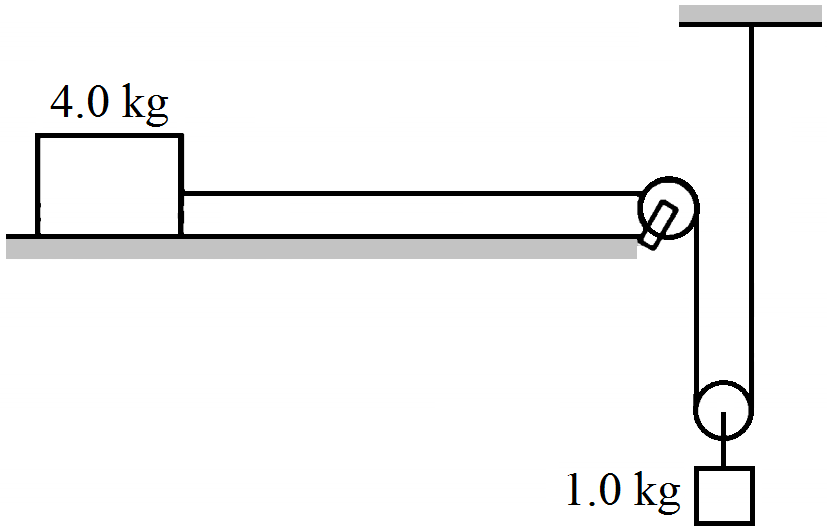
Consider the situation shown in figure. The system is released from rest and the block of mass 1.0kg is found to have a speed 0.3m/s after it has descended through a distance of 1m. Find the coefficient of kinetic friction between the block and the table.

Three rods of lengths 20cm each and area of cross section 1cm2 are joined to form a triangle ABC. The conductivities of the rods are $\text{K}_\text{AB}=50\text{Js}^{-1}\text{m}^{-1}{^{\circ}}\text{C}^{-1},\ \text{K}_\text{BC}=200\text{Js}^{-1}\text{m}^{-1}{^{\circ}}\text{C}^{-1}$ and $\text{K}_\text{AC}=400\text{Js}^{-1}\text{m}^{-1}{^{\circ}\text{C}}^{-1}.$ The junctions A, B and C are maintained at 40°C, 80°C and 80°C respectively. Find the rate of heat flowing through the rods AB, AC and BC.
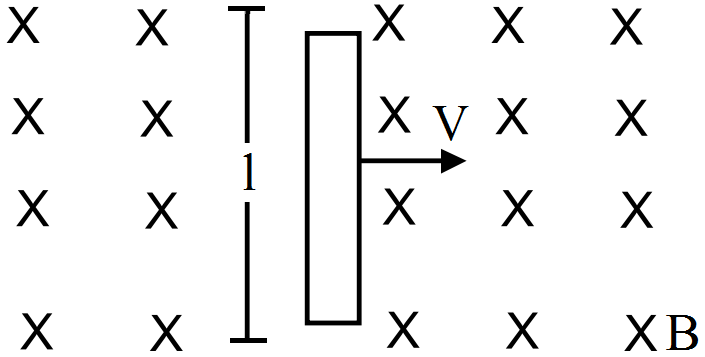
A conducting wire of length l, lying normal to a magnetic field B, moves with a velocity v, as shown in the figure.
  1. Find the average magnetic force on a free electron of the wire.
  2. Due to this magnetic force, electrons concentrate at one end, resulting in an electric field inside the wire. The redistribution stops when the electric force on the free electrons balances the magnetic force. Find the electric field developed inside the wire when the redistribution stops.
  3. What potential difference is developed between the ends of the wire?

In an imaginary atmosphere, the air exerts a small force F on any particle in the direction of the particle's motion. A particle of mass m projected upward takes a time t1 in reaching the maximum height and t2 in the return journey to the original point. Then:
  1. t1 < t2
  2. t1 > t2
  3. t1 = t2
  4. The relation between t1 and t2 depends on the mass of the particle.
An object 1.5 cm in size is placed on the side of the convex lens in the arrangement (a) above. The distance between the object and the convex lens is 40 cm. Determine the magnification produced by the two-lens system, and the size of the image.