Question
Answer the following question:
Some scientists have predicted that a global nuclear war on the earth would be followed by a severe ‘nuclear winter’ with a devastating effect on life on earth. What might be the basis of this prediction?
Answer

A global nuclear war on the surface of the Earth would have disastrous consequences. Post - nuclear war, the Earth will experience severe winter as the war will produce clouds of smoke that would cover maximum parts of the sky, thereby preventing solar light form reaching the atmosphere. Also, it will lead to the depletion of the ozone layer.

Need a full question paper?

Generate a complete, print-ready paper with questions like this in minutes — across 16+ boards, with answer keys.

Start Generating Free

Similar questions

Assume that a tunnel is dug along a chord of the earth, at a perpendicular distance $\frac{\text{R}}{2}$ from the earth's centre where R is the radius of the earth. The wall of the tunnel is frictionless.
  1. Find the gravitational force exerted by the earth on a particle of mass m placed in the tunnel at a distance x from the centre of the tunnel.
  2. Find the component of this force along the tunnel and perpendicular to the tunnel.
  3. Find the normal force exerted by the wall on the particle.
  4. Find the resultant force on the particle.
  5. Show that the motion of the particle in the tunnel is simple harmonic and find the time period.
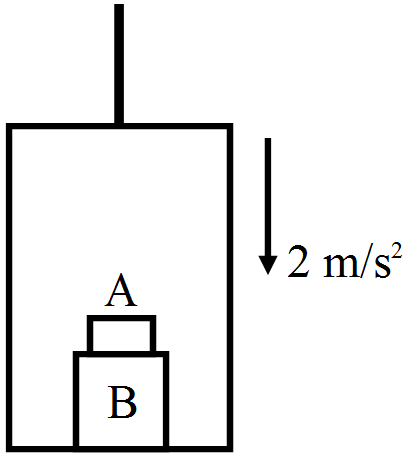
The elevator shown in figure is descending with an acceleration of $2m/s^2$. The mass of the block A is 0.5kg. What force is exerted by the block A on the block B?
Consider an electron in front of metallic surface at a distance d (treated as an infinite plane surface). Assume the force of attraction by the plate is given as $\frac{1}{2}\frac{\text{q}^2}{4\pi\in_0\text{d}^2}$
Calculate work in taking the charge to an infinite distance from the plate. Taking d = 0.1nm, find the work done in electron volts. [Such a force law is not valid for d < 0.1nm].
Prove : $n_{12}=\frac{1}{n_{21}}$
Explain with the help of a circuit diagram how the value of unknown resistance can be determined using a Wheatstone Bridge. Give the formula used.
A bar magnet of length 1cm and cross-sectional area $1.0cm^2$ produces a magnetic field of $1.5 \times 10.$ T at a point in end-on position at a distance 15cm away from the centre.
  1. Find the magnetic moment M of the magnet.
  2. Find the magnetization I of the magnet.
  3. Find the magnetic field B at the centre of the magnet.
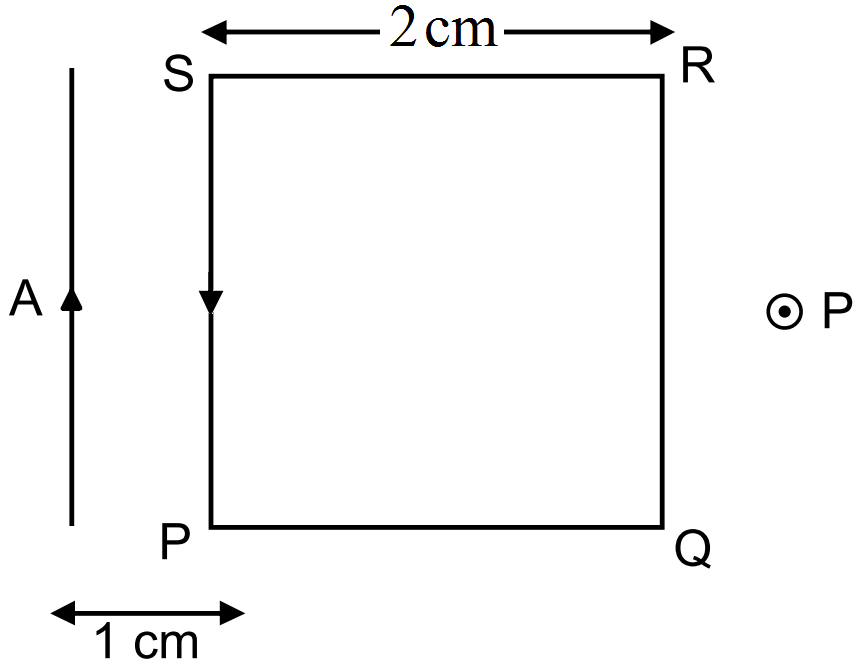
A square loop PQRS carrying a current of 6.0A is placed near a long wire carrying 10A as shown in figure.
  1. Show that the magnetic force acting on the part PQ is equal and opposite to that on the part RS.
  2. Find the magnetic force on the square loop.
Meeta’s father was driving her to the school. At the traffic signal, she noticed that each traffic light was made of many tiny lights instead of a single bulb. When Meeta asked this question to her father, he explained the reason for this. Answer the following questions based on above information:
  1. What were the values displayed by Meeta and her father?
  2. What answer did Meeta’s father give?
  3. What are the tiny lights in traffic signals called and how do these operate?
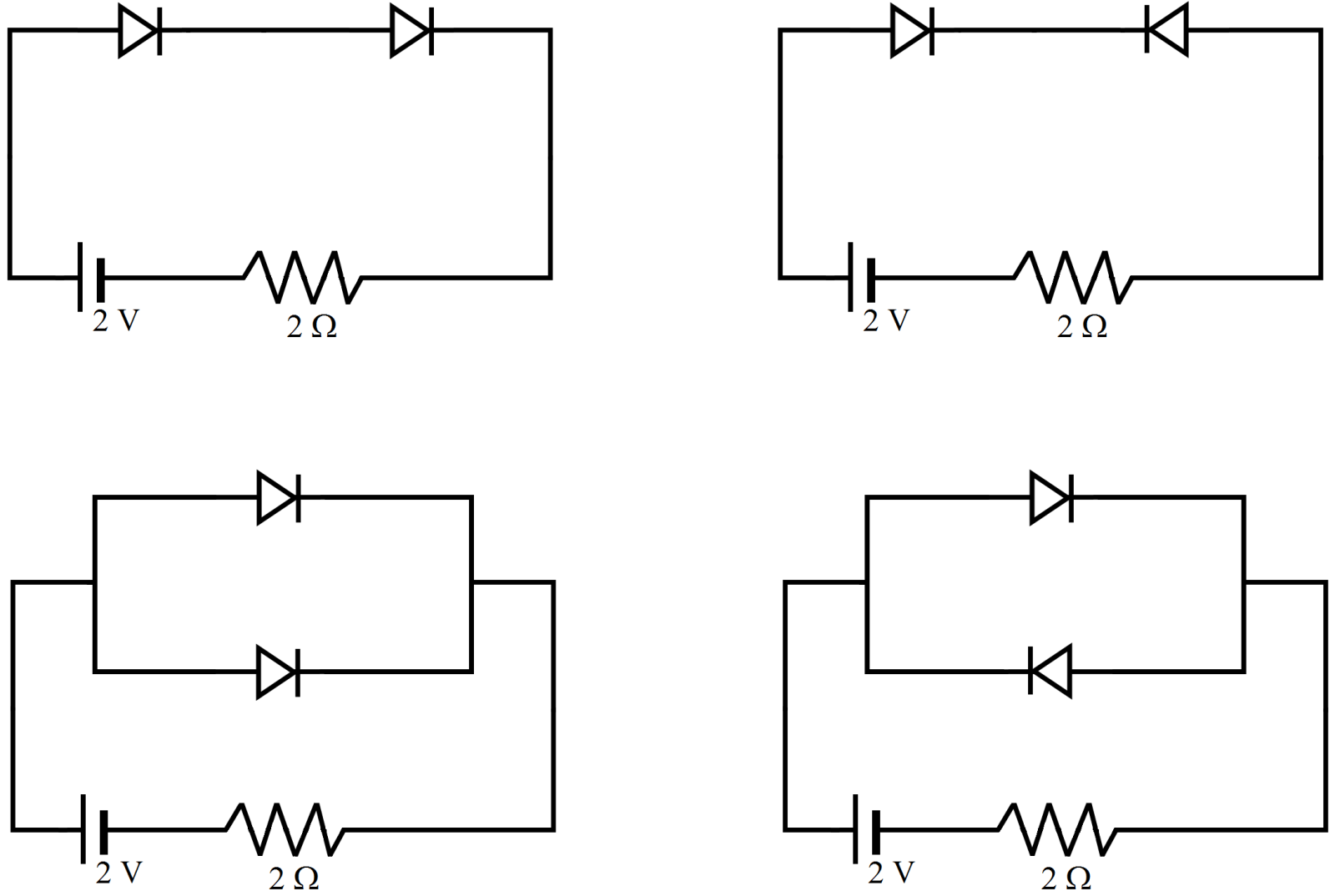
Find the currents through the resistances in the circuits shown in figure.
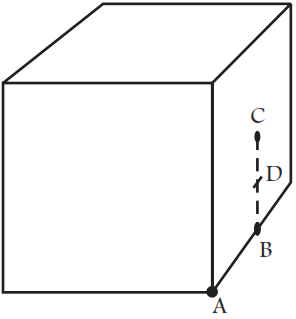
What will be the total flux through the faces of the cube (Fig.) with side of length a if a charge q is placed at:
  1. A: a corner of the cube.
  2. B: mid-point of an edge of the cube.
  3. C: centre of a face of the cube.
  4. D: mid-point of B and C.