Question
Answer the following question:
When viewing through a compound microscope, our eyes should be positioned not on the eyepiece but a short distance away from it for best viewing. Why? How much should be that short distance between the eye and eyepiece?
Answer

When we place our eyes too close to the eyepiece of a compound microscope, we are unable to collect much refracted light. As a result, the field of view decreases substantially. Hence, the clarity of the image gets blurred.
The best position of the eye for viewing through a compound microscope is at the eye-ring attached to the eyepiece. The precise location of the eye depends on the separation between the objective lens and the eyepiece.

Need a full question paper?

Generate a complete, print-ready paper with questions like this in minutes — across 16+ boards, with answer keys.

Start Generating Free

Similar questions

The electric current in a discharging R-C circuit is given by $\text{i}=\text{i}_0\text{e}^{-\frac{\text{t}}{\text{RC}}}$ where i0, R and C are constant parameters and t is time. Let $\text{i}_0=2.00\text{A},\text{R}=600\times10^5\Omega$ and $\text{C}=0.500\mu\text{F}.$
  1. Find the current at t = 0.3s.
  2. Find the rate of change of current at t = 0.3s.
  3. Find approximately the current at t = 0.31s.
The yellow colour has a greater luminous efficiency as compared to the other colours. Can we increase the illuminating power of a white light source by putting a yellow plastic paper around this source?
What is a capacitive and an inductive AC circuit? Explain.
A wire-loop confined in a plane is rotated in its own plane with some angular velocity. A uniform magnetic field exists in the region. Find the emf induced in the loop.
Write two points of difference between n-type and p-type semiconductors.
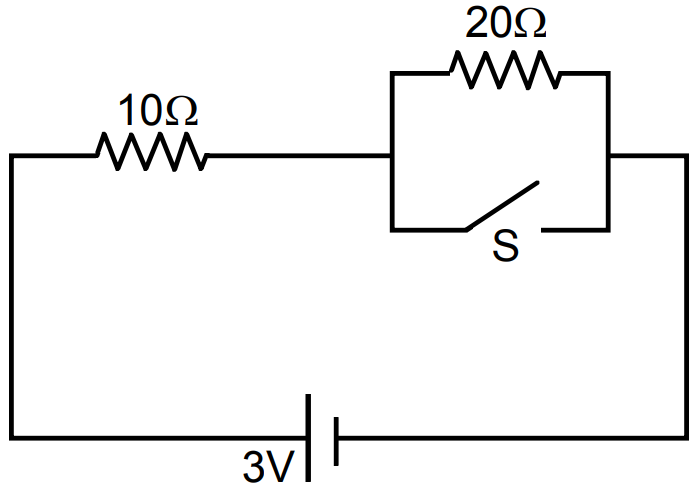
Consider the circuit shown in figure. Find the current through the $10\Omega$ resistor when the switch S is (a) Open (b) Closed.

The selling rate of a radioactive isotope is decided by its activity. What will be the second-hand rate of a one month old $\text{ }^{32}\text{P}\big(\text{t}_{\frac{1}{2}}=14.3\text{days}\big)$ source if it was originally purchased for 800 rupees?
The battery discussed in the previous question is suddenly disconnected. Is a current induced in the other loop? If yes, when does it start and when does it end? Do the loops attract each other or repel?
Obtain the expression of electric field at any point by continuous distribution of charge on a line.
Describe experiment of two stationary coil which explains clectromagnetic induction.