Question
Answer the following question:
Why should gases be insulators at ordinary pressures and start conducting at very low pressures?

Answer

At low pressures, uner the effect of high voltage ions acquire sufficient energy; have a chance to reach their respective electrodes and constitute a current.
At ordinary pressures, positive ions and electrons produced by ionisation of gas molecules do not reach the electrodes even at higher potential. this is because, of the frequent collisions of molecules and their recombination.
Hence, at ordinary pressure gases act as insulators.

Need a full question paper?

Generate a complete, print-ready paper with questions like this in minutes — across 16+ boards, with answer keys.
Start Generating Free

Similar questions

An electron moves in a circular orbit $6^{15} \times 10^{15}$ times per second. Find the magnitude of current in the loop.
Consider an amplifier circuit using a transistdf. The output power is several times greater than the input power. Where does the extra power come from?
Derive an expression for drift velocity of free electrons in a conductor in terms of relaxation time.
Consider a small cube of volume 1mm3 at the centre of a circular loop of radius 10cm carrying a current of 4A. Find the magnetic energy stored inside the cube.
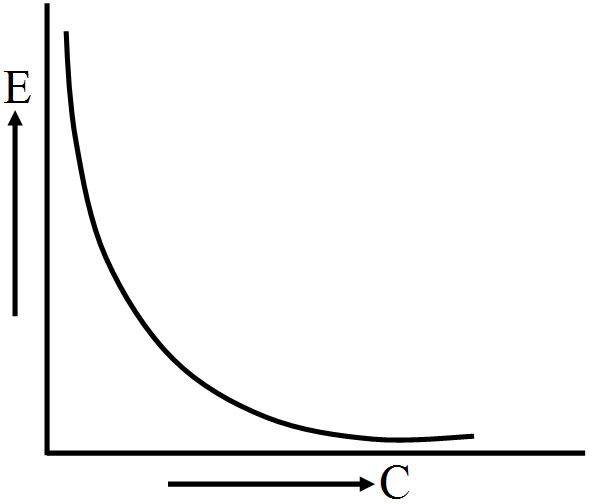
The graph shown here shows the variation of total energy (E) stored in a capacitor against the value of the capacitance (C) itself. Which of the two: the charge on capacitor or the potential used to charge it, is kept constant for this graph?

How does Ampere-Maxwell law explain the flow of current through a capacitor when it is being charged by a battery? Write the expression for the displacement current in terms of the rate of change of electric flux.
In half-wave rectification, what is the output frequency if the input frequency is 50 Hz. What is the output frequency of a full-wave rectifier for the same input frequency.
Assume that each iron atom has a permanent magnetic moment equal to 2 Bohr magnetons (1 bohr magneton equals 9.27 × 10⁻²⁴A-m2). The density of atoms in iron is 8.52 × 1028 atoms/m3.
  1. Find the maximum magnetization I in a long cylinder of iron.
  2. Find the maximum magnetic field B on the axis inside the cylinder.
A proton and a deuteron have the same velocity; what is the ratio of their de Broglie wavelengths?
Two metallic wires P and Q of the same material and same length but different cross-sectional areas A1 and A2 are joined together and then connected to a source of emf. Find the ratio of the drift velocities of free electrons in the wires P and Q, if the wires are connected (i) in series, and (ii) in parallel.