Question
Answer the following question:
You have learnt that plane and convex mirrors produce virtual images of objects. Can they produce real images under some circumstances? Explain.
Answer

Yes, Plane and convex mirrors can produce real images as well. If the object is virtual, i.e., if the light rays converging at a point behind a plane mirror (or a convex mirror) are reflected to a point on a screen placed in front of the mirror, then a real image will be formed.

Need a full question paper?

Generate a complete, print-ready paper with questions like this in minutes — across 16+ boards, with answer keys.

Start Generating Free

Similar questions

Which of the following can act as a source of electromagnetic waves:
  1. A charge moving with a constant velocity.
  2. A charge moving in a circular orbit.
  3. A charge at rest.
Give reason.
A capacitor, made of two parallel plates each of plate area A and separation d, is being charged by an external ac source. Show that the displacement current inside the capacitor is the same as the current charging the capacitor.
Write a short note on 'Valves' in electronics.
Write the formula for the torque acting on a current$-$carrying coil placed in uniform magnetic field and explain its stable and unstable equilibrium states.
Two identical phase connected waves, each of intensity $I _0$, are producing interference patterns. Write the value of the resultant intensity at the places of (i) constructive interference, (ii) destructive interference
Write and explain the law of conservation of electric charge.
Calculate the amount of heat radiated per second by a body of surface area $12\ cm^2$ kept in thermal equilibrium in a room at temperature $20^\circ C.$ The emissivity of the surface $= 0.80$ and $\sigma=6.0\times10^{-8}\text{Wm}^{-2}\text{K}^{-4}.$
Calculate the de-Broglie wavelength of the electron orbiting in the n =2 state of hydrogen atom.
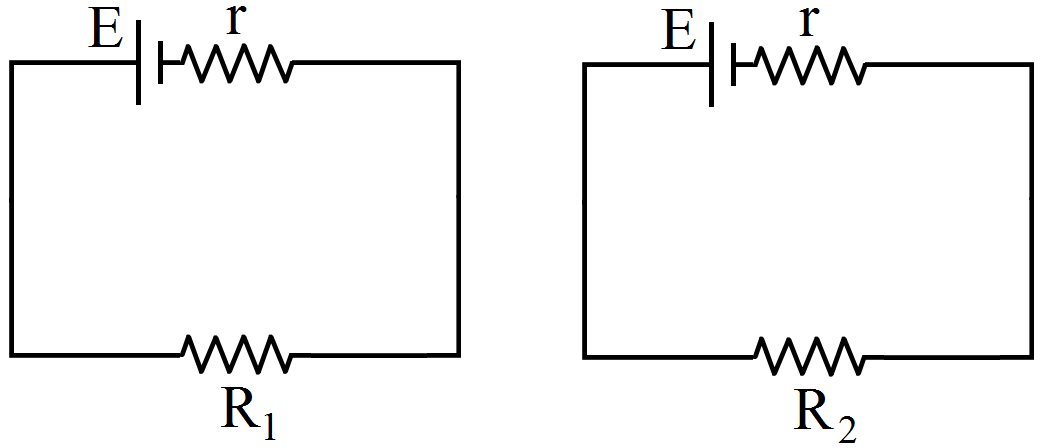
Two unequal resistances $R_1$ and $R_2$ are connected across two identical batteries of emf $\varepsilon$ and internal resistance $r.$ Can the thermal energies developed in $R_1$ and $R_{2}$ be equal in a given time. If yes, what will be the condition?
A semiconductor has equal electron and hole concentration of $6 \times 10^8/m^3.$ On doping with certain impurity, electron concentration increases to $9 \times 10^{12}/m^3.$
  1. Identify the new semiconductor obtained after doping.
  2. alculate the new hole concentration.