Question
Answer the following questions:
A low voltage supply from which one needs high currents must have very low internal resistance. Why?

Answer

According to Ohm's law, the relation for the potential is V = IR
Voltage (V) is directly proportional to current (I).
R is the internal resistance of the source.
$\text{I}=\frac{\text{V}}{\text{R}}$
If V is low, then R must be very low, so that high current can be drawn from the source.

Need a full question paper?

Generate a complete, print-ready paper with questions like this in minutes — across 16+ boards, with answer keys.
Start Generating Free

Similar questions

A boy is standing on a platform which is free to rotate about its axis. The boy holds an open umbrella in his hand. The axis of the umbrella coincides with that of the platform. The moment of inertia of ''the platform plus the boy system'' is 3.0 × 10⁻³kg-m2 and that of the umbrella is 2.0 × 10³kg-m2. The boy starts spinning the umbrella about the axis at an angular speed of 2.0rev/s with respect to himself. Find the angular velocity imparted to the platform.
The atmospheric temperature in the cities on sea-coast change very little. Explain.
State factors on which the resistance of a conductor depends.
Name the nucleus for which the binding energy per nucleon is maximum.
Ultraviolet radiations of different frequencies ν1 and ν2, are incident on two photosensitive materials having work functions W1 and W2 (W1 > W2) respectively. The kinetic energy of the emitted photoelectrons is same in both the cases. Which one of the two relations will be of the higher frequency?
If an object far away from a convex mirror moves towards the mirror, the image also moves. Does it move faster, slower or at the same speed as compared to the object?
A pivoted aluminium bar falls much more slowly through a small region containing a magnetic field than a similar bar of an insulating material. Explain.
What is doping ? - Explain.
Explain dielectric strength and dielectric breakdown.
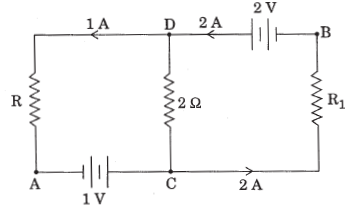
In the given circuit, assuming point A to be at zero potential, use Kirchhoff's rules to determine the potential at point B.