Question
Answer the following questions:
Explain the changes the primary oocyte undergoes while in different follicular stages before ovulation.

Answer

Changes in the primary oocyte:
  • Each primary oocyte gets surrounded by a single layer of granulosa cells and is known as primary follicle.
  • Primary follicle get surrounded by more layers of granulosa cells and a new theca and form secondary follicle.
  • A secondary follicle transforms into tertiary follicle characterised by a fluid-filled space, the antrum.
  • Primary oocyte undergoes first meiotic division and produces two unequal haploid cells-a large haploid secondary oocyte and a tiny first polar body.
  • The tertiary follicle further changes into the mature Graafian follicle.
  • The secondary oocyte forms a new membrane called zona pellucida around it.

Need a full question paper?

Generate a complete, print-ready paper with questions like this in minutes — across 16+ boards, with answer keys.
Start Generating Free

Similar questions

Read the following and answer any four questions from (i) to (v) given below:
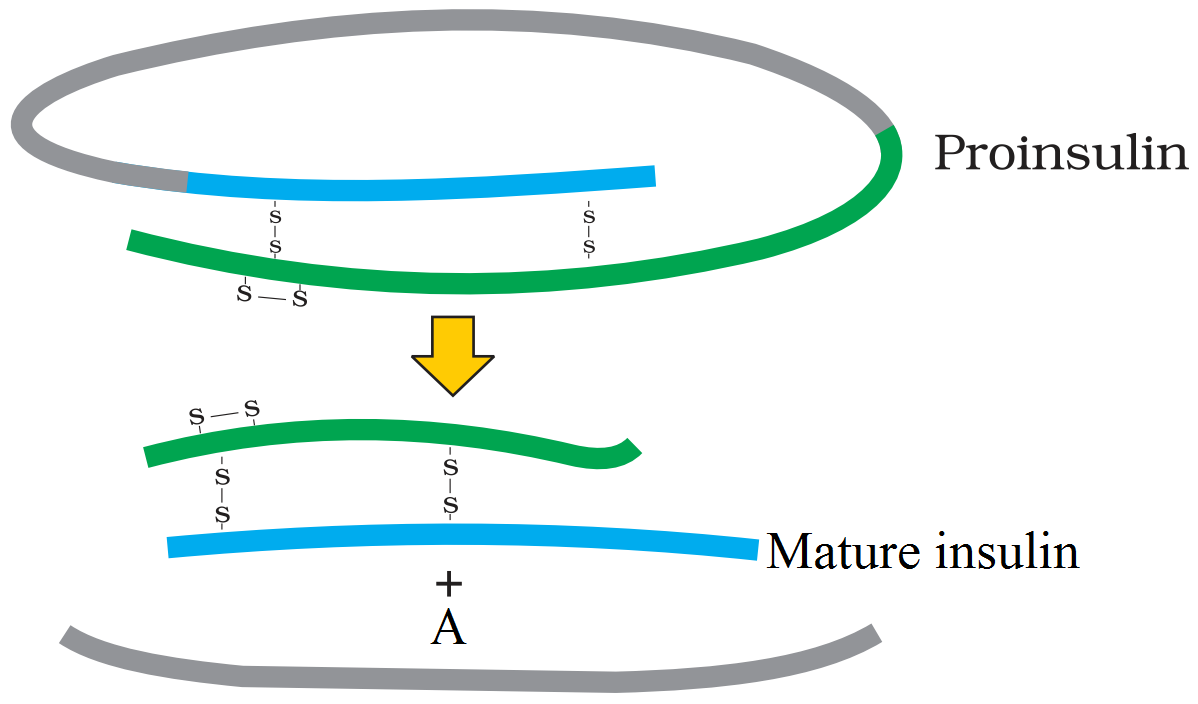
Insulin used to cure diabetes was earlier extracted from pancreas of slaughtered cattle and pigs. Insulin extracted from an animal source, though caused some patients to develop allergy or other types of reactions to the foreign protein. Human insulin consists of two short polypeptide chains : chain A and chain B, that are linked together by disulphide bridges. In mammals including humans, insulin is synthesised as a pro-hormone which contains an extra stretch called the C-peptide. This C peptide is not present in mature insulin and is removed during maturation into insulin.
  1. Identify A in the given figure.
  1. Polypeptide chain A.
  2. Polypeptide chain B.
  3. Polypeptide chain C.
  4. None of these.
  1. The following is a list of some stages involved in producing human insulin from genetically engineered bacteria.
  1. The bacteria are cultured in a fermenter for large scale production.
  2. Recombinant insulin is extracted from the bacterial cells that expresses insulin gene.
  3. The same restriction enzyme is used again to cut the bacterial plasmid for insertion of the human insulin gene.
  4. Bacteria take up the plasmid carrying the insulin gene.
  5. A restriction enzyme is used to cut human DNA to extract the insulin gene.
Select the correct order of these stages.
  1. 1, 5, 3, 4, 2
  2. 2, 4, 3, 5, 1
  3. 4, 5, 3, 2, 1
  4. 5, 3, 4, 1, 2
  1. To insert the insulin gene into bacterial DNA, both the bacterial plasmid and the human chromosome containing the insulin gene are treated with the same restriction enzyme. Using the same restriction enzyme ensures that
  1. DNA ligase is able to join the segments of human and bacterial DNA.
  2. The exact length of nucleotides matching the insulin gene is removed from the plasmid.
  3. Both the bacterial and human DNA will contain sticky ends.
  4. Sticky ends in the cut plasmid and insulin gene are complementary.
  1. Why is the fermentor important for the production of human insulin by transgenic bacteria?
  1. It provides optimal conditions for the transgenic to multiply rapidly.
  2. It facilitates the extraction and purification of insulin from the transgenic bacteria.
  3. It maximise the rate of fermentation of the transgenic bacteria.
  4. It provides the low-oxygen conditions that are important for insulin production.
  1. A bacteriologist carries out his first attempt at engineering E.coli with the gene for human insulin. During the process, he realises that his stock of DNA ligase has depleted but decides to continue anyway. What is a likely consequence of his decision?
  1. Bacteria with the rDNA will not be able to form colonies in a fermenter.
  2. The resulting plasmids are not able to enter the E.coli bacteria even after applying heat shock.
  3. The resulting E.coli bacteria do not contain the human insulin gene.
  4. The bacterial plasmids do not have sticky ends and are unable to accommodate the human gene.
m-RNA, t-RNA and r-RNA.
Distinguish between : Natural ecosystem and artificial ecosystem.
Phase of cell formation
A child suffering from thalassemia is born to a normal couple. But the mother is being blamed by the family for delivering a sick baby.
  1. What is thalassemia?
  2. How would you counsel the family not to blame the mother for delivering a child suffering from this disease? Explain.
  3. List the values your counselling can propagate in the families.
Human female is not fertile after menopause whereas males can produce gametes at any age after puberty. Analyse the statement and schematically represent a comparison between gametogenesis in males and females.
Explain the various types of interactions between species.
What is adaptive radiation? Explain with suitable example.
Given below is a table showing the genotypes and the phenotypes of blood groups in the human population.
Genotype
Phenotype
$W$
$Y$
$I^B I^O$
$Z$
$I^A I^B$
$O$
$X$
$O$
  1. Identify the genotype Wand X, and the phenotype Y and Z.
  2. Name the pattern of inheritance exhibited by the phenotypes Y and Z in the table.
Complete the table.
Number Type No. of Pairs Region
———— Cervical ————- —————
$T_{1 }– T_{12}$ ————- $12$ pairs ————-
$L_1 – L_5$ ————- $5$ pairs Lower back
————- Sacral ————- Pelvic
————– Coccygeal ————— Tall region