Question
Answer the following questions:
Interstellar space has an extremely weak magnetic field of the order of 10–12 T. Can such a weak field be of any significant consequence? Explain.
Answer

From the relation, $\text{R}=\frac{\text{m v}}{\text{e B}},\ \Big[\because\frac{\text{mv}^2}{\text{R}}=\text{qvB}\Big]$
we find that an extremely minute field bends charged particles in a circle of very large radius. Over a small distance, the deflection due to the circular orbit of such large radius may not be noticeable, but over the gigantic interstellar distances, the deflection can significantly affect the passage of charged particles, e.g., cosmic rays.

Need a full question paper?

Generate a complete, print-ready paper with questions like this in minutes — across 16+ boards, with answer keys.

Start Generating Free

Similar questions

Draw a ray diagram of a reflecting type telescope. State two advantages of this telescope over a refracting telescope.
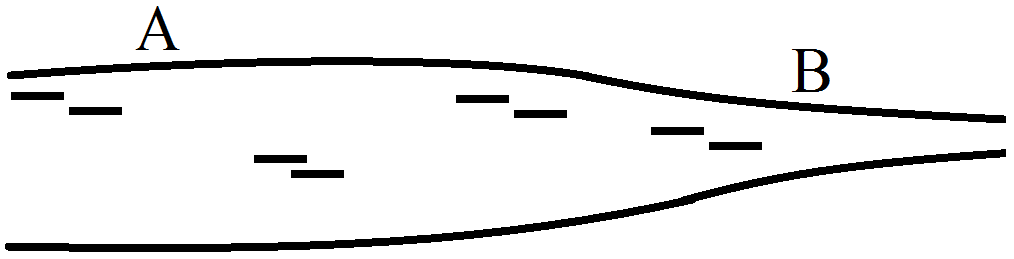
Water flows through a horizontal tube of variable cross-section. The area of cross-section at A and B are 4mm2 and 2mm2 respectively. If 1cc of water enters per second through A, find,
  1. The speed ofwater at A.
  2. The speed of water at B.
  3. Thepressure difference PA - PB.

The force on a charged particle due to electric and magnetic fields is given by $\overrightarrow{\text{F}}=\text{q}\overrightarrow{\text{E}}+\text{q}\overrightarrow{\text{v}}\times\overrightarrow{\text{B}}.$ Suppose $\overrightarrow{\text{E}}$ is along the X-axis and $\overrightarrow{\text{B}}$ along the Y-axis. In what direction and with what minimum speed v should a positively charged particle be sent so that the net force on it is zero?
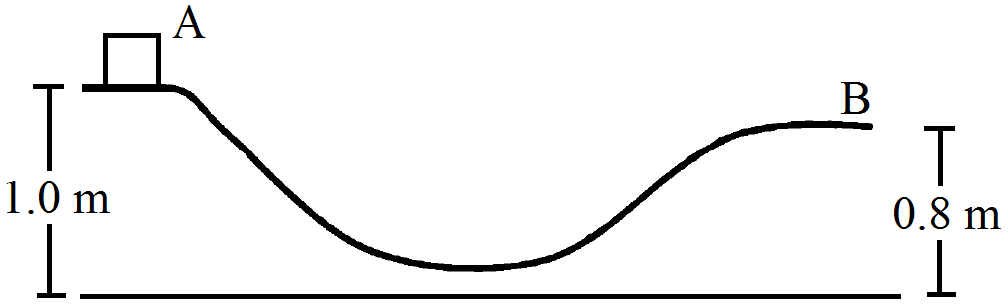
A block of mass 1kg is placed at the point A of a rough track shown in figure. If slightly pushed towards right, it stops at the point B of the track. Calculate the work done by the frictional force on the block during its transit from A to B.

The light emitted in the transition n = 3 to n = 2 in hydrogen is called $\text{H}_\alpha$ light. Find the maximum work function a metal can have so that $\text{H}_\alpha$ light can emit photoelectrons from it.
According to Maxwell's theory of electrodynamics, an electron going in a circle should emit radiation of frequency equal to its frequency of revolution. What should be the wavelength of the radiation emitted by a hydrogen atom in ground state if this rule is followed?
Two tuning forks vibrate with the same amplitude but the frequency of the first is double the frequency of the second. Which fork produces more intense sound in air?
Which one of the two, an ammeter or a milliammeter, has a higher resistance and why?
Can a process on an ideal gas be both adiabatic and isothermal?