Question
Answer the following questions on the basis of the given plot of potential energy vs reaction coordinate:
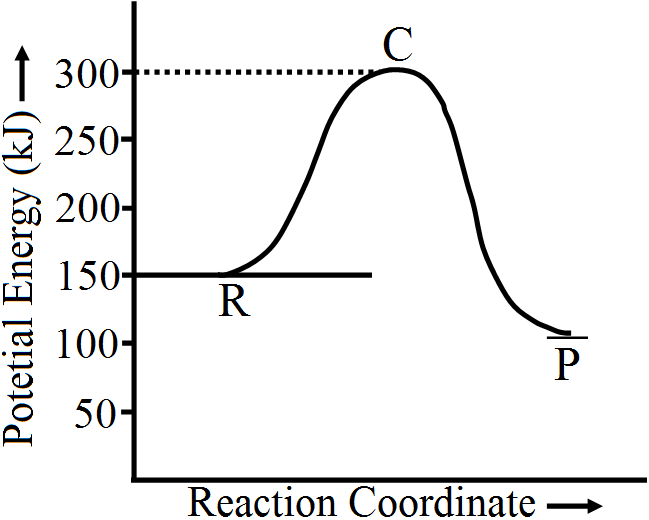
  1. What is the threshold energy for the reaction?
  2. What is the activation energy for forward reaction?
  3. What is the activation energy for backward reaction?
  4. What is enthalpy change for the forward reaction?
Answer

  1. Threshold energy for the reaction $=300 \mathrm{KJ}\ \mathrm{mol}^{-1}$.
  2. Activation energy for the forward reaction $=300-150=150 \mathrm{KJ}\ \mathrm{mol}^{-1}$.
  3. Activation energy for the backward reaction $=300-100=200 \mathrm{KJ}\ \mathrm{mol}^{-1}$.
  4. Enthalpy change for the forward reaction $\Delta_t \mathrm{H}=100-150=-50 \mathrm{KJ}\ \mathrm{mol}^{-1}$.

Need a full question paper?

Generate a complete, print-ready paper with questions like this in minutes — across 16+ boards, with answer keys.

Start Generating Free

Similar questions

Which alkyl halide from the following pairs would you expect to react more rapidly by an $S_N2$ mechanism? Explain your answer.
$\text{CH}_3\text{CH}_2\text{CH}_2\text{CH}_2\text{Br}\ \text{or}\ \text{CH}_3\text{CH}_2\text{CH}\text{CH}_3\\\ \ \ \ \ \ \ \ \ \ \ \ \ \ \ \ \ \ \ \ \ \ \ \ \ \ \ \ \ \ \ \ \ \ \ \ \ \ \ \ \ \ \ \ \ \ \ \ \ \ \ \ \ \ \ \ \mid\\\ \ \ \ \ \ \ \ \ \ \ \ \ \ \ \ \ \ \ \ \ \ \ \ \ \ \ \ \ \ \ \ \ \ \ \ \ \ \ \ \ \ \ \ \ \ \ \ \ \ \ \ \ \ \ \text{Br}$
Explain giving reason:
The enthalpies of atomisation of the transition metals are high.
What is meant by the Ketal? Give an example.
Write the mechanism of the following reaction: $ \text{CH}_{3}\text{CH}_{2}\text{OH}\xrightarrow{HBr}\text{CH}_{3}\text{CH}_{2}\text{Br}+\text{H}_{2}\text{O}$
Define thermoplastics and thermosetting polymers with two examples of each.
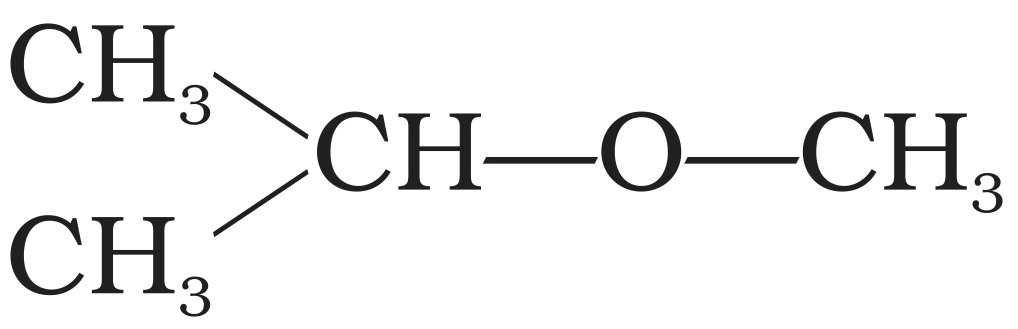
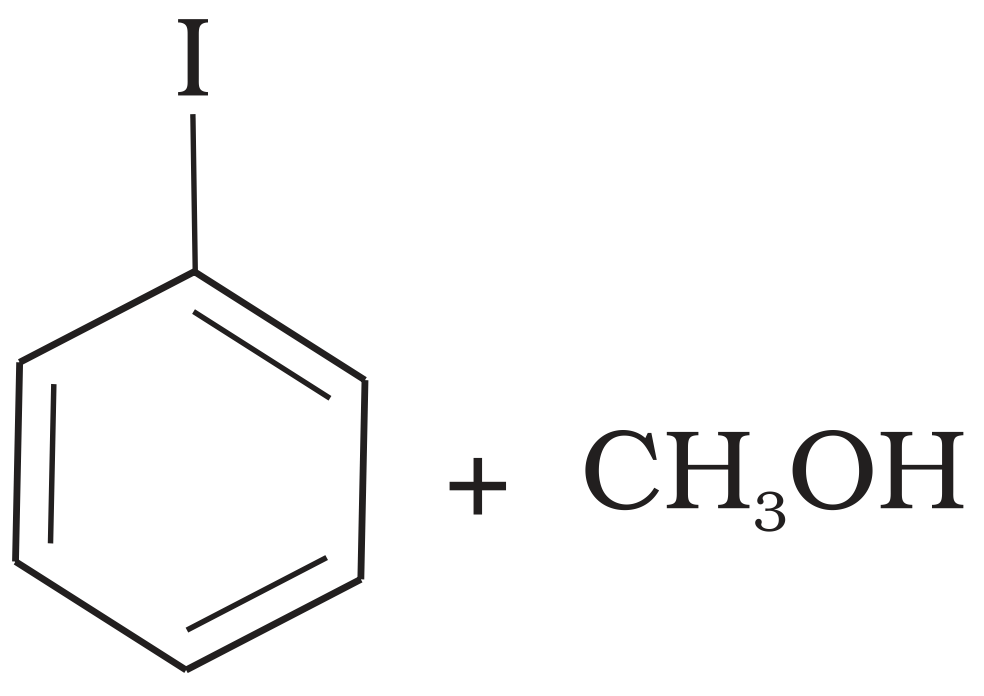
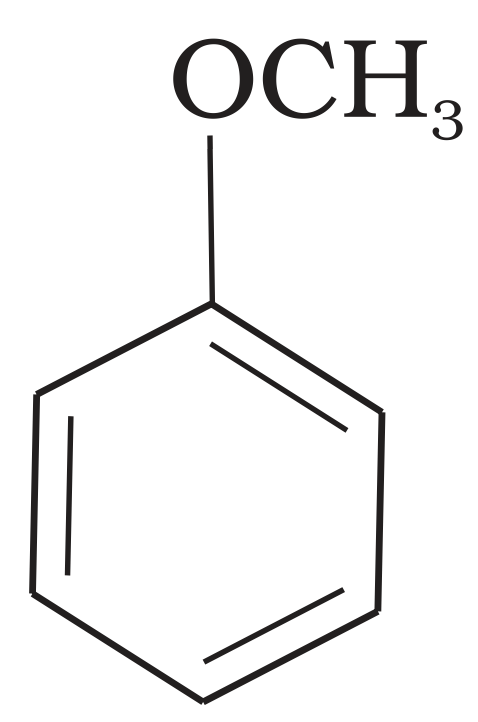
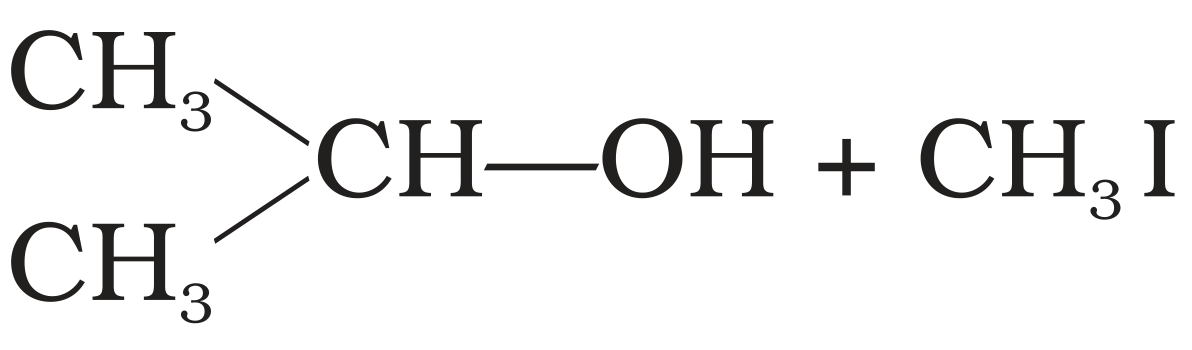
Match the starting materials given in Column I with the products formed by these (Column II) in the reaction with II.
 
Column I
 
Column II
(i)
$CH_3-o-CH_3$
(a)
(ii)
(b)
$\ \ \ \ \ \ \ \ \ \ \ \ \ \text{CH}_3 \\ \ \ \ \ \ \ \ \ \ \ \ \ \ \ | \\ \text{CH}_3-\text{C}-\text{I}+\text{CH}_3\text{OH} \\ \ \ \ \ \ \ \ \ \ \ \ \ \ \ | \\ \ \ \ \ \ \ \ \ \ \ \ \ \ \text{CH}_3$
(iii)
$\ \ \ \ \ \ \ \ \ \ \ \ \ \text{CH}_3 \\ \ \ \ \ \ \ \ \ \ \ \ \ \ \ | \\ \text{H}_3\text{C}-\text{C}-\text{O}-\text{CH}_3 \\ \ \ \ \ \ \ \ \ \ \ \ \ \ \ | \\ \ \ \ \ \ \ \ \ \ \ \ \ \ \text{CH}_3$
(c)
(iv)
(d)
$CH_3-OH + CH_3-I$
 
 
(e)
 
 
(f)
 
 
(g)
$\ \ \ \ \ \ \ \ \ \ \ \ \ \text{CH}_3 \\ \ \ \ \ \ \ \ \ \ \ \ \ \ \ | \\ \text{CH}_3-\text{C}-\text{OH}+\text{CH}_3\text{I} \\ \ \ \ \ \ \ \ \ \ \ \ \ \ \ | \\ \ \ \ \ \ \ \ \ \ \ \ \ \ \text{CH}_3$
Which one of the following electrolytes is the most effective for the coagulation of $Fe(OH)_3$ sol and why$?NaCl,\ Na_2SO_4,\ Na_3PO_4$
Why is zinc not extracted from zinc oxide through reduction using $CO?$
Ferric oxide crystallises in a hexagonal close-packed array of oxide ions with two out of every three octahedral holes occupied by ferric ions. Derive the formula of the ferric oxide.
Write the reactions of D-glucose which can’t be explained by its open-chain structure. How can cyclic structure of glucose explain these reactions?