Question
Answer the following questions:
Why does a paramagnetic sample display greater magnetisation (for the same magnetising field) when cooled?
Answer

Owing to therandorn thermal motion of rnolecules, the allqnments of dipoles get disrupted at high temperatures. on cooling, this disruption is reduced. Hence, a pararnaqnetlc sample displays greater magnetisation when cooled.

Need a full question paper?

Generate a complete, print-ready paper with questions like this in minutes — across 16+ boards, with answer keys.

Start Generating Free

Similar questions

A particle executing simple harmonic motion comes to rest at the extreme positions. Is the resultant force on the particle zero at these positions according to Newton's first law?
Which characteristic of electromagnetic waves it is assumed that light waves are electromagnetic?
Why should the spring/suspension wire in a moving coil galvanometer have low torsional constant?
Consider the energy density in a solenoid at its centre and that near its ends. Which of the two is greater?
What will be the value of maximum and minimum capacitances oblained from the combinations of three capacitors. each of which has a capacitance of $6 \mu F$ ?
When a charged particle moves in a magnetic field normally; what quantity changes the particle’s speed, particle’s energy, path of motion of the particle?
Answer the following question:
When a tiny circular obstacle is placed in the path of light from a distant source, a bright spot is seen at the centre of the shadow of the obstacle. Explain why?
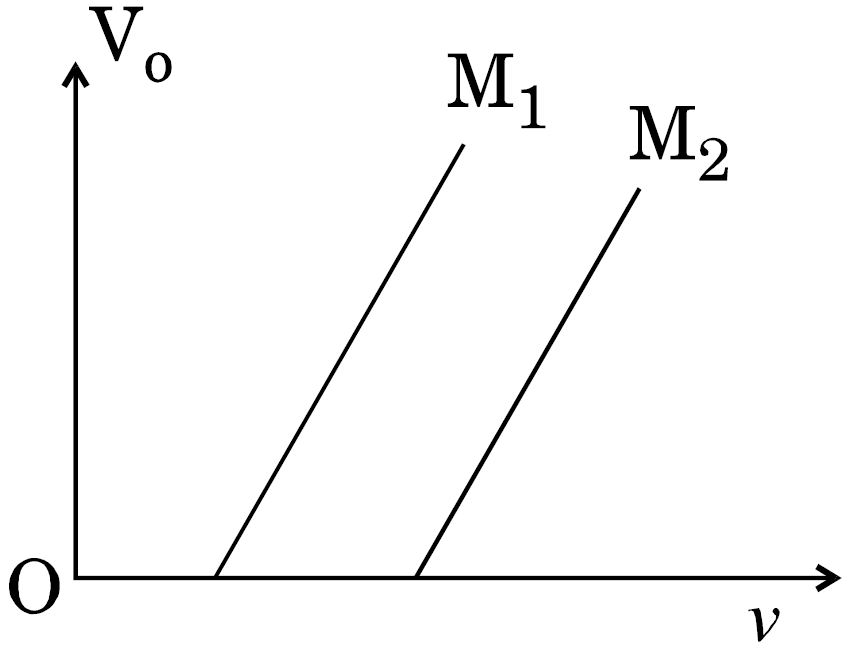
The variation of the stopping potential (V0) with the frequency (v) of the light incident on two different photosensitive surfaces M1 and M2 is shown in the figure. Identify the surface which has greater value of the work function.

"Magnetic field lines form closed curves." Why?
The coercive force for a certain permanent magnet is 4.0 × 10⁴A/m. Thia magnet is placed inside a long solenoid of 40 turns/cm and a current is passed in the solenoid to demagnetise it completely. Find the current.