Question
Answer the following questions:
Write the formulae for the following coordination compounds:
  1. Tetraammineaquachloridocobalt (III)chloride.
  2. Potassiumtetracyanonickelate (II).

Answer

a. $\left[\mathrm{Co}\left(\mathrm{NH}_3\right)_4\left(\mathrm{H}_2 \mathrm{O}\right) \mathrm{Cl}\right] \mathrm{Cl}_2$
b. $\mathrm{K}_2\left[\mathrm{Ni}(\mathrm{CN})_4\right]$

Need a full question paper?

Generate a complete, print-ready paper with questions like this in minutes — across 16+ boards, with answer keys.

Start Generating Free

Similar questions

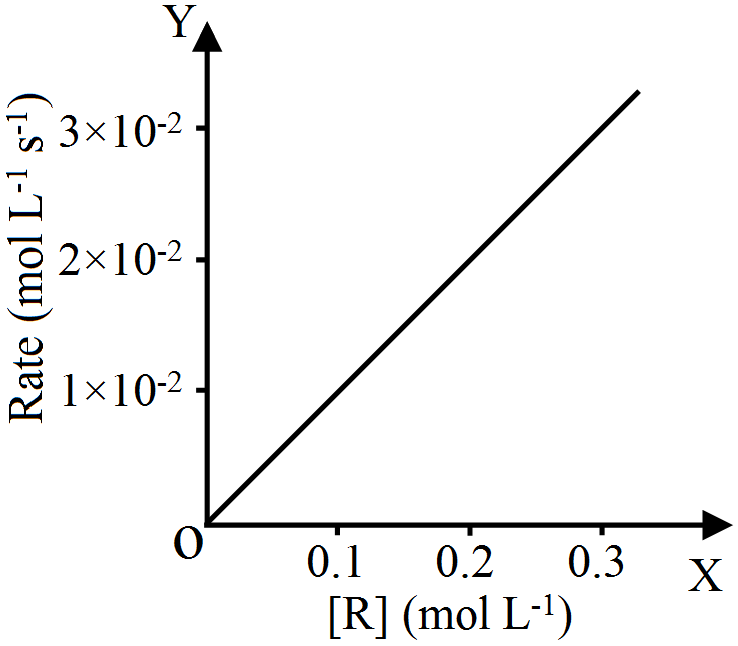
The rate for the reaction $R→P$ is rate = k[R]. It has been shown graphically below. What is rate constant for the reaction?
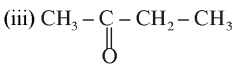
Give the products of following carbonyl compounds when oxidised with acidic $KMnO _4$ or acidic $K _2 Cr _2 O _7$.
(i) $CH _3 CHO$
(ii) $CH _3 COCH _3$
Image
The following results have been obtained during the kinetic studies of the reaction:
$2A + B \rightarrow C + D$
Experiment [$A]/mol\ L^{-1}$ $[B]/mol\ L^{-1}$ Initial rate of formation of

$D/mol\ L^{-1} \min^{-1}$
$I$ $0.1$ $0.1$ $6.0 \times 10^{-3}$
$II$ $0.3$ $0.2$ $7.2 \times 10^{-2}$
$III$ $0.3$ $0.4$ $2.88 \times 10^{-1}$
$IV$ $0.4$ $0.1$ $2.40 \times 10^{-2}$
Determine the rate law and the rate constant for the reaction.
The reaction between $A$ and $B$ is first order with respect to $A$ and zero order with respect to $B$. Fill in the blanks in the following table:
Experiment $[A]/mol\ L^{-1}$ $[B]/mol\ L^{-1}$ Initial rate$/mol\ L^{-1}\ min^{-1}$
$I$ $0.1$ $0.1$ $2.0 \times 10^{-2}$
$II$ $-$ $0.2$ $4.0 \times 10^{-2}$
$III$ $0.4$ $0.4$ $-$
$IV$ $-$ $0.2$ $2.0 \times 10^{-2}$
Explain types of Electrodes with examples
Consider a certain reaction $A \rightarrow$ Products with $k = 2.0 \times 10^{-2} s^{-1}.$ Calculate the concentration of $A$ remaining after $100 \ s$ if the initial concentration of $A$ is $1.0 \ mol \ L^{-1}.$
Define the following terms: (1) Coordination entity (2) Central atom / ion.
What type of substances would make better permanent magnets, ferromagnetic or ferrimagnetic. Justify your answer.
Iron has a body centred cubic unit cell with a cell edge of 286.65 pm. The density of iron is $7.87\ g\ cm^{–3}.$ Use this information to calculate Avogadro’s number $($At mass of $Fe = 56\ g\ mol^{–1}).$
A solution prepared by dissolving $1.25g$ of oil of winter green (methyl salicylate) in $99.0g$ of benzene has a boiling point of $80.31^\circ C.$ Determine the molar mass of this compound. $(B.P.$ of pure benzene $= 80.10^\circ C$ and Kb for benzene $= 2.53^\circ C\ kg\ mol^{–1}).$