Question
Antinodal curves correspond to _____ interference.

Answer

  1. Constructive
Explanation:
Antinodal curves correspond to constructive interference.

Need a full question paper?

Generate a complete, print-ready paper with questions like this in minutes — across 16+ boards, with answer keys.
Start Generating Free

Similar questions

Stopping potential for photoelectrons(a) Does not depend on the frequency of the incident light(b) Does not depend upon the nature of the cathode material(c) Depends on both the frequency of the incident light and nature of the cathode material(d) Depends upon the intensity of the incident light


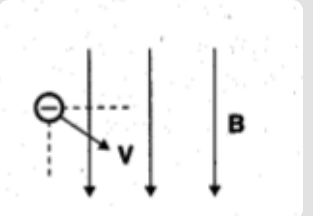
An electron moving with velocity 'v' enters a magnetic field as shown in the above figure. Identify in which direction, the electron will experience a force?
For the production of characteristic $\mathrm{K}_\gamma \ X-$ray, the electron transition is
Two coils are placed close to each other. The mutual inductance of the pair of coils depends upon(a) The currents in the two coils(b) The rates at which currents are changing in the two coils(c) Relative position and orientation of the two coils(d) The materials of the wires of the coils


Which of the following statement is correct(a) Liquids obey fully the ohm's law(b) Liquids obey partially the ohm's law(c) There is no relation between current and p.d. for liquids(d) None of the above


If a magnet of length $10 \ cm$ and pole strength $40 \mathrm{A}-\mathrm{m}$ is placed at an angle of $45^{\circ} \mathrm{in}$ an uniform induction field of intensity $2 \times 10^{-4} \mathrm{T}$, the couple acting on it is
Which of the following is vector quantity(a) Current density(b) Current(c) Wattless current(d) Power
       
Two bulbs are working in parallel order. Bulb $A$ is brighter than bulb $B.$ If $\mathrm{R}_{\mathrm{A}}$ and $\mathrm{R}_{\mathrm{B}}$ are their resistance respectively then
Charge motion within the Gaussian surface gives changing physical quantity:
When the accelerating voltage applied on the electrons increased beyond a critical value(a) Only the intensity of the various wavelengths is increased(b) Only the wavelength of characteristic relation is affected(c) The spectrum of white radiation is unaffected(d) The intensities of characteristic lines relative to the white spectrum are increased but there is no change in their wavelength