MCQ
Antinodal curves correspond to $........$ interference.
  • Constructive
  • B
    Destructive
  • C
    Where intensity is less than maximum but not completely zero.
  • D
    None of these

Answer

Correct option: A.
Constructive

Antinodal curves correspond to constructive interference.

Need a full question paper?

Generate a complete, print-ready paper with questions like this in minutes — across 16+ boards, with answer keys.
Start Generating Free

Similar questions

In the visible region of the spectrum the rotation of the place of polarization is given by $\theta = a + \frac{b}{{{\lambda ^2}}}$. The optical rotation produced by a particular material is found to be $30^o $ per mm at $\lambda = 5000$Å and $50^o $ per mm at $\lambda = 4000{\rm{Å}}$. The value of constant $a $ will be
A ray of light is incident on one face of a transparent slab of thickness $15 \,cm$. The angle of incidence is $60^o$. If the lateral displacement of the ray on emerging from the parallel plane is $5$ index of the material of the slab is
If a hole is made at the centre of a bar magnet, then its magnetic moment will
The fossil bone has a ${}^{14}C:{}^{12}C$ ratio, which is $\left[ {\frac{1}{{16}}} \right]$ of that in a living animal bone. If the halflife of ${}^{14}C$ is $5730\, years$, then the age of the fossil bone is ..........$years$
Electric field and magnetic field in Thomson mass spectrograph are applied
The energy of an X- ray photon of wavelength 1.65 Å is (h = $6.6 \times 10^{-34} \mathrm{~J}-\mathrm{sec}$, 1eV =$ 1.6.\times 10^{-19} \mathrm{~J}$)
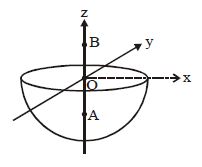
Consider $a$ uniformly charged hemispherical shell of radius $R$ and charge $Q$ . If field at point $A (0, 0, -z_0)$ is $ \vec E$ then field at point $(0, 0, z_0)$ is $[z_0 < R]$ 
In an experiment of photoelectric effect the stopping potential was measured to be $V_{1}$ and $V_{2}$ with incident light of wavelength $\lambda$ and $\frac \lambda 2$ respectively. The relation between $V_{1}$ and $V_{2}$ is
A light beam travelling along the $X$-axis with planar wavefront is incident on a medium of thickness $t$. In the region, where light is falling the refractive index can be taken to be varying such that $(d n / d y) > 0$. The light beam on the other side of the medium will emerge
An electron is moving with an initial velocity $\text{v}=\text{v}_0\hat{\text{i}}$ and is in a magnetic field $\text{B}=\text{B}_0\hat{\text{j}}$. Then it's de Broglie wavelength: