MCQ
Antiparticle of electron is
  • A
    $_0{n^1}$
  • B
    $_1{H^1}$
  • Positron
  • D
    Neutrino

Answer

Correct option: C.
Positron
c
(c) Antiparticle of electron $_{-1} e^{0}$ is positron $_{+1} e^{0}$

Need a full question paper?

Generate a complete, print-ready paper with questions like this in minutes — across 16+ boards, with answer keys.

Start Generating Free

Similar questions

The specific resistance of all metals is most affected by
The first law of thermodynamics is concerned with the conservation of
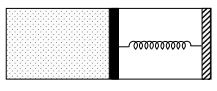
An ideal monoatomic gas is confined in a horizontal cylinder by a spring loaded piston (as shown in the figure). Initially the gas is at temperature $T _1$, pressure $P_1$ and volume $V_1$ and the spring is in its relaxed state. The gas is then heated very slowly to temperature $T_2$, pressure $P _2$ and volume $V _2$. During this process the piston moves out by a distance $x$. Ignoring the friction between the piston and the cylinder, the correct statement$(s)$ is(are)

$(A)$ If $V_2=2 V_1$ and $T_2=3 T_1$, then the energy stored in the spring is $\frac{1}{4} P_1 V_1$

$(B)$ If $V_2=2 V_1$ and $T_2=3 T_1$, then the change in internal energy is $3 P_1 V_1$

$(C)$ If $V_2=3 V_1$ and $T_2=4 T_1$, then the work done by the gas is $\frac{7}{3} P_1 V_1$

$(D)$ If $V_2=3 V_1$ and $T_2=4 T_1$, then the heat supplied to the gas is $\frac{17}{6} P_1 V_1$
$n$ identical waves each of intensity $I_0$ interfere with each other. The ratio of maximum intensities if the interference is $(i)$ coherent and $(ii)$ incoherent is :
A body of mass $10\, kg$ is moving with a constant velocity of $10 \,m/s$. When a constant force acts for $4 \,seconds$ on it, it moves with a velocity $2 \,m/sec$ in the opposite direction. The acceleration produced in it is...........$m/{\sec ^2}$
If wavelength of a wave is $\lambda = 6000Å.$ Then wave number will be
Conditions of diffraction is
The work done in blowing a soap bubble of radius $0.2\, m$ is (the surface tension of soap solution being $0.06\, N/m$)
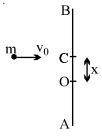
$A$ uniform rod $AB$ of length $L$ and mass $M$ is lying on a smooth table. $A$ small particle of mass $m$ strike the rod with a velocity $v_0$ at point $C$ at a distance $x$ from the centre $O$. The particle comes to rest after collision. The value of $x$, so that point $A$ of the rod remains ststionary just after collision is:
A fighter plane is moving in a vertical circle of radius $‘r’$. Its minimum velocity at the highest point of the circle will be