MCQ
Any point on the x-axis is of the form:
  • A
    (x, y)
  • B
    (0, y)
  • C
    (x, 0)
  • D
    (x, x)

Answer

  1. (x, 0)
    Solution:
    Any point on x-axis is of the form (x, 0), where $\text{x}\neq0,$
    Since its y-coordinate will be 0 always.

Need a full question paper?

Generate a complete, print-ready paper with questions like this in minutes — across 16+ boards, with answer keys.
Start Generating Free

Similar questions

Write the correct answer in the following:
The quadrilateral formed by joining the mid-points of the sides of a quadrilateral PQRS, taken in order, is a rhombus, if:
  1. PQRS is a rhombus.
  2. PQRS is a parallelogram.
  3. Diagonals of PQRS are perpendicular.
  4. Diagonals of PQRS are equal.
Zero of the zero polynomial is:
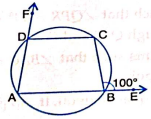
In Fig. sides AB and AD of quadrilateral ABCD are produced to E and F respectively. If $\angle C B E=100^{\circ}$, then $\angle C D F=$
Image
In the following, write the correct answer.
In $\triangle\text{PQR}$ if $\angle\text{R}=\angle\text{P}$ and QR = 4cm and PR = 5cm. Then, the length of PQ is:
  1. 4cm
  2. 5cm
  3. 2cm
  4. 2.5cm
If the length of each edge of a regular tetrahedron is ' $a$ ', then its surface area is
Which of the following is a false statement?
  1. If the diagonals of a rhombus are 18cm and 14cm, then its area is 126cm2.
  2. Area of a ||gm $=\frac{1}{2}\times$ base × corresponding height.
  3. A parallelogram and a rectangle on the same base and between the same parallels are equal in area.
  4. If the area of a ||gm with one side 24cm and corresponding height h cm is 192cm2, then h = 8cm.
Two right circular cones have equal radii. If their slant heights are in the ratio 4 : 3, then their respective curved surface areas are in the ratio:
ABCD is a cyclic quadrilateral such that $\angle\text{ADB}=30^\circ$ and $\angle\text{DCA}=80^\circ,$ then $\angle\text{DAB}=$