Question
Are all three types of strains possible in gases and liquid also?

Answer

No, only volume strains occurs in gases and liquids. Therefore, liquids and gases have only Bulk modulus of elasticity. In liquid and gases there is no meaning of length and shape.

Need a full question paper?

Generate a complete, print-ready paper with questions like this in minutes — across 16+ boards, with answer keys.
Start Generating Free

Similar questions

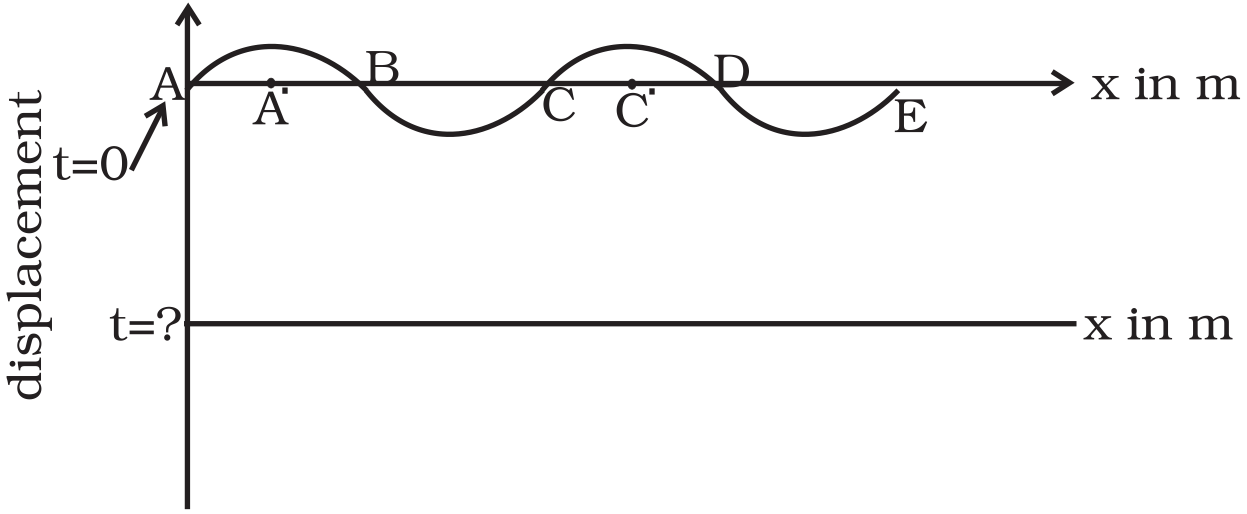
The pattern of standing waves formed on a stretched string at two instants of time are shown in The velocity of two waves superimposing to form stationary waves is $360\ ms^{–1}$ and their frequencies are $256\ Hz$
  1. Calculate the time at which the second curve is plotted.
  2. Mark nodes and antinodes on the curve.
  3. Calculate the distance between $A′$ and $C′.$
Solve with due regard to significant figures:
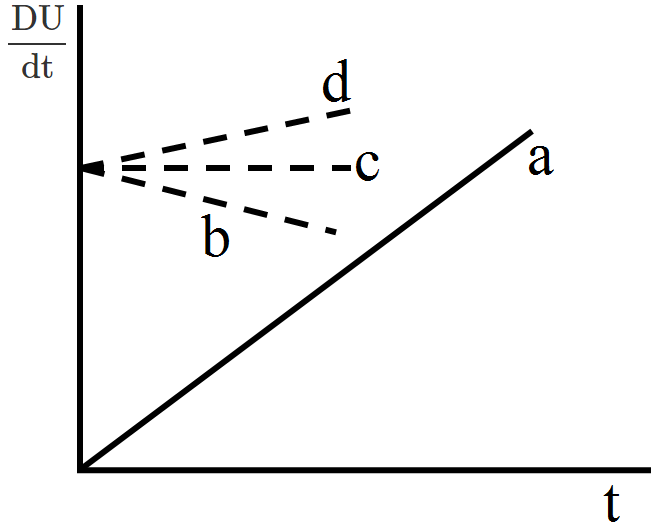
A constant current i is passed through a resistor. Taking the temperature coefficient of resistance into account, indicate which of the plots shown in figure best represents the rate of production of thermal energy in the resistor.
State work-energy theorem.
Which working substance is used in reversible Carnot engine?
Which measurement is more accurate between vernier callipers and screw gauge?
Calculate the time required to heat 20 kg of water from $10^{\circ} \mathrm{C}$ to $35^{\circ} \mathrm{C}$ using an immersion heater rated 1000 W .
Assume that $80 \%$ of the power input is used to heat the water. Specific heat capacity of water $=42000 \mathrm{~J} \mathrm{~kg}^{-1} \mathrm{~K}^{-1}$.
If the n forces are acting on an object can be expressed sequentially by the sides of n sided polygon, then the object will be.............
For any arbitrary motion in space, which of the following relations are true: $\text{v}_\text{average}=\frac{1}{2}(\text{v}(\text{t}_1)+\text{v}(\text{t}_2))$ (The ‘average’ stands for average of the quantity over the time interval $t_1$ to $t_2$)
Which of the length measurements is the most accurate and why?
  1. $500.0\ cm.$
  2. $0.0005\ cm.$
  3. $6.00\ cm.$