Question
Are matter waves electromagnetic?

Answer

Matter waves are not electromagnetic. The reason is that electromagnetic waves are produced by accelerated charges while matter waves or de Broglie waves are associated with neutral particles. In fact de Broglie waves are the probability waves; they tell the probability of location of particle in a certain region of space.

Need a full question paper?

Generate a complete, print-ready paper with questions like this in minutes — across 16+ boards, with answer keys.

Start Generating Free

Similar questions

Write and explain principle of superposition for stationary electric forces.
A positive ion having just one electron ejects it if a photon of wavelength $288\mathring{\text{A}}$ or less is absorbed by it. Identify the ion.
Derive the equation of the missing term in the Ampere circuital law OR Derive the equation of displacement current and write its unit and definition.
Find the Q-value and the kinetic energy of the emitted α-particle in the $\alpha $-decay of

  1.  $^{226}_{88}\text{Ra}$ and  
  2. $^{220}_{86}\text{Rn}.$

Given

$\text{m}(^{226}_{88}\text{Ra})=226.02540\text{ u}.$ $\text{m}(^{222}_{86}\text{Rn})=222.01750\text{ u}.$

$\text{m}(^{222}_{86}\text{Rn})=220.01137\text{ u}.$ $\text{m}(^{216}_{84}\text{Po})=216.00189\text{ u}.$
Show that the wavelength of electro-magnetic radiation is equal to the de-Broglie wavelength of its quantum (photon).
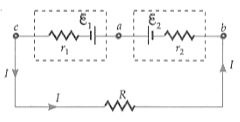
In Figure, $\varepsilon_1$ and $\varepsilon_2$ are respectively 2.0 V and 4.0 V and the resistances $r _1, r _2$ and R are respectively $1.0 \Omega$ $2.0 \Omega$ and $5.0 \Omega$. Calculate the current in the circuit. Also, calculate:
i. potential difference between the points b and a,
ii. potential difference between a and c.
Image
A (i) series (ii) parallel combination of two given resistors is connected, one by one, across a cell. In which case will the terminal potential difference, across the cell have a higher value?
Show that the radiation pressure exerted by an EM wave of intensity I on a surface kept in vacuum is I/c.
The ends of a metre stick a.re maintained at 100°C and 0°C. One end of a rod is maintained at 25°C. Where should its other end be touched on the metre stick so that there is no heat current in the rod in steady state?
Suppose a monochromatic X-ray beam of wavelength 100pm is sent through a Young's double slit and the interference pattern is observed on a photographic plate placed 40cm away from the slit. What should be the separation between the slits so that the successive maxima on the screen are separated by a distance of 0.1mm?