MCQ
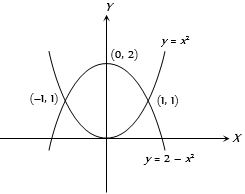
Area bounded by curves $y = {x^2}$ and $y = 2 - {x^2}$ is
 
  • $8/3$
  • B
    $3/8$
  • C
    $3/2$
  • D
    None of these

Answer

Correct option: A.
$8/3$
a
(a) $y = {x^2}$.....$(i)$

$y = 2 - {x^2}$.....$(ii)$

$\therefore $ By equation $(i)$ and $(ii),$ we get,  $x = \pm 1$

$\therefore $ $y = \pm 1$

$\therefore $ Required area $ = 2\left[ {\int_0^1 {(2 - {x^2})dx - \int_0^1 {{x^2}dx} } } \right]$

$ = 2\,\left[ {2x - \frac{{2{x^3}}}{3}} \right]_0^1 = 4\left[ {x - \frac{{{x^3}}}{3}} \right]_0^1 = 4\left( {\frac{2}{3}} \right) = \frac{8}{3}$.
Need a full question paper?

Generate a complete, print-ready paper with questions like this in minutes — across 16+ boards, with answer keys.

Start Generating Free

Similar questions

$\int\limits_{2 - \log 3}^{3 + \log 3} {\frac{{\log (4 + x)}}{{\log (4 + x) + \log (9 - x)}}\,\,dx = } $
If the first term of a $G.P.$ ${a_1},\;{a_2},\;{a_3},..........$ is unity such that $4{a_2} + 5{a_3}$ is least, then the common ratio of $G.P.$ is
If odds against solving a question by three students are $2 : 1 ,  5:2$ and $5:3$ respectively, then probability that the question is solved only by one student is
The coefficients $a, b, c$ in the quadratic equation $ax ^2+ bx + c = 0$ are chosen from the set $\{1, 2, 3, 4, 5, 6, 7, 8\}$. The probability of this equation having repeated roots is :
$\int_{}^{} {{x^{51}}({{\tan }^{ - 1}}x + {{\cot }^{ - 1}}x)\;dx = } $
Let $\alpha$ be a non$-$zero real number. Suppose $f: R \rightarrow R$ is a differentiable function such that $f(0)=2$ and $\lim _{x \rightarrow-\infty} f ( x )=1$. If $f^{\prime}( x )=\alpha f(x)+3$, for all $x \in R$, then $f\left(-\log _e 2\right)$ is equal to $..........$
The distance of the point $(7,10,11)$ from the line $\frac{x-4}{1}=\frac{y-4}{0}=\frac{z-2}{3}$ along the line $\frac{x-9}{2}=\frac{y-13}{3}=\frac{z-17}{6}$ is
If a unit vector lies in $yz-$ plane and makes angles of ${30^o}$ and ${60^o}$ with the positive $y-$ axis and $z-$ axis respectively, then its components along the co-ordinate axes will be
Let $\alpha=\frac{(4 !) !}{(4 !)^{3 !}}$ and $\beta=\frac{(5 !) !}{(5 !)^{4 !}}$. Then :
If the ${5^{th}}$ term of a $G.P.$ is $\frac{1}{3}$ and ${9^{th}}$ term is $\frac{{16}}{{243}}$, then the ${4^{th}}$ term will be