MCQ
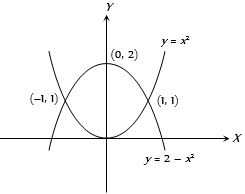
Area bounded by curves $y = {x^2}$ and $y = 2 - {x^2}$ is
 
  • $8/3$
  • B
    $3/8$
  • C
    $3/2$
  • D
    None of these

Answer

Correct option: A.
$8/3$
a
(a) $y = {x^2}$.....$(i)$

$y = 2 - {x^2}$.....$(ii)$

$\therefore $ By equation $(i)$ and $(ii),$ we get,  $x = \pm 1$

$\therefore $ $y = \pm 1$

$\therefore $ Required area $ = 2\left[ {\int_0^1 {(2 - {x^2})dx - \int_0^1 {{x^2}dx} } } \right]$

$ = 2\,\left[ {2x - \frac{{2{x^3}}}{3}} \right]_0^1 = 4\left[ {x - \frac{{{x^3}}}{3}} \right]_0^1 = 4\left( {\frac{2}{3}} \right) = \frac{8}{3}$.
Need a full question paper?

Generate a complete, print-ready paper with questions like this in minutes — across 16+ boards, with answer keys.

Start Generating Free

Similar questions

$\int(\frac{\cos2\theta-1}{\cos2\theta+1})\text{d}\theta=$
  1. $\tan\theta-\theta+\text{c}$
  2. $\theta+\tan\theta+\text{c}$
  3. $\theta-\tan\theta+\text{c}$
  4. $-\theta-\cot\theta+\text{c}$
In an LPP, if the objective function $Z=a x+b y$ has the same maximum value on two corner points of the feasible region, then the number of points at which $Z_{\max }$ occurs is
Let $A \equiv  (\lambda  + 2, 1 - 2\lambda , \lambda  + 2)$ and $B \equiv  (2k + 1, k, k +1)$ and $ \lambda , k  \in  R.$ Then minimum distance between $A$ and $B$ is -
If $y = \sin px$ and ${y_n}$ is the $n^{th}$ derivative of $y$, then $\left| {\begin{array}{*{20}{c}}
y&{{y_1}}&{{y_2}}\\
{{y_3}}&{{y_4}}&{{y_5}}\\
{{y_6}}&{{y_7}}&{{y_7}}
\end{array}} \right|$ is equal to
If the system of equations, $x + 2y - 3z = 1$, $(k + 3)z = 3,$ $(2k + 1)x + z = 0$is inconsistent, then the value of $ k$  is
The differential coefficient of $f(\sin x)$ with respect to $x,$ where $f(x) = \log x$, is
The corner points of the feasible region are $(0,0),(16,0),(8,12),(0,20) .$ The maximum and minimum values of $\mathrm{Z}=22 x+18 y$ are $m$ and $n$ respectively then $m+n=\ldots$
If $f(x) = 3x - 5$, then ${f^{ - 1}}(x)$
What is integrating factor of $\frac{\text{dy}}{\text{dx}}+\text{y}\sec\text{x}=\tan\text{x}?$
  1. $\sec\text{x}+\tan\text{x}$
  2. $\log(\sec\text{x}+\tan\text{x})$
  3. $\text{e}^{\sec\text{x}}$
  4. $\sec{\text{x}}$ 
The area bounded by the curves $y = -  \sqrt { - \,x}$  and $x = -\sqrt { - \,y} $  where $x, y \le 0$