MCQ
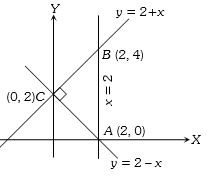
Area bounded by lines $y = 2 + x,$ $y = 2 - x$ and $x = 2$ is
  • A
    $3$
  • $4$
  • C
    $8$
  • D
    $16$

Answer

Correct option: B.
$4$
b
(b) Obviously, triangle $ACB$ is right angled at $C$.

$\therefore$ Required area $ = \frac{1}{2} \times AC \times BC$

$ = \frac{1}{2} \times 2\sqrt 2 \times 2\sqrt 2 = 4\,\, sq. \,unit$.
Need a full question paper?

Generate a complete, print-ready paper with questions like this in minutes — across 16+ boards, with answer keys.

Start Generating Free

Similar questions

For a biased die, the probabilities for different faces to turn up are

$Face :$ $1$ $2$ $3$ $4$ $5$ $6$
$P(F)$ $0.2$ $0.22$ $0.11$ $0.25$ $0.05$ $0.17$

The die is tossed and you are told that either face $4$ or face $5$ has turned up. The probability that it is face $4$ is

If  $f(x) = \frac{{{e^{2x}} - {{(1 + 4x)}^{1/2}}}}{{\ln (1 - {x^2})}}$ for $x \ne 0,$ then $f$ has
Solution of $(xy\cos xy + \sin xy)dx + {x^2}\cos xy\,dy = 0$ is
In a regular triangular prism the distance from the centre of one base to one of the vertices of the other base is $l.$ The altitude of the prism for which the volume is greatest
If $\omega $ is cube root of unity, then root of the equation $\left| {\begin{array}{*{20}{c}}
  {x + 2}&\omega &{{\omega ^2}} \\ 
  \omega &{x + 1 + {\omega ^2}}&1 \\ 
  {{\omega ^2}}&1&{x + 1 + \omega } 
\end{array}} \right| = 0$ is 
if x lies in the interval [0, 1], then the least value of x2 + x + 1 is :
  1. $3$ 
  2. $\frac{3}{4}$
  3. $1$
  4. none of these.
If $A=\left[\begin{array}{cc}8 & 0 \\ 4 & -2 \\ 3 & 6\end{array}\right]$ and $B=\left[\begin{array}{cc}2 & -2 \\ 4 & 2 \\ -5 & 1\end{array}\right],$ then find the matrix $X$, such that $2 \mathrm{A}+3 \mathrm{X}=5 \mathrm{B}$.
Let $a, b , c \in R$ be such that $a ^{2}+ b ^{2}+ c ^{2}=1$ If $a \cos \theta=b \cos \left(\theta+\frac{2 \pi}{3}\right)=\operatorname{ccos}\left(\theta+\frac{4 \pi}{3}\right)$ where $\theta=\frac{\pi}{9},$ then the angle between the vectors $a \hat{i}+b \hat{j}+c \hat{k}$ and $b \hat{i}+c \hat{j}+a \hat{k}$ is
If $c = \frac {1}{2}$ and $f(x) = 2x -x^2$ , then interval of $x$ in which $LMVT$, is applicable, is 
Evaluate: $\int_{-\pi}^\pi x^{10} \sin ^7 x d x$