MCQ
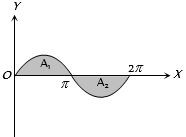
Area bounded by $y = x\sin x$ and $x - $ axis between $x = 0$ and $x = 2\pi ,$ is
  • A
    $0$
  • B
    $2\pi \,\, sq. \,unit$
  • C
    $\pi \,\, sq. \,unit$
  • $4\pi \,\, sq. \,unit$

Answer

Correct option: D.
$4\pi \,\, sq. \,unit$
d
(d) Required area is ${A_1} + {A_2}$

$= \int_0^\pi {y\,\,dx + \left| {\int_\pi ^{2\pi } {y\,dx} } \right| = 4\pi \,sq.} \,unit$
Need a full question paper?

Generate a complete, print-ready paper with questions like this in minutes — across 16+ boards, with answer keys.

Start Generating Free

Similar questions

A hyperbola, having the transverse axis of length $2 \sin \theta$, is confocal with the ellipse $3 x^2+4 y^2=12$. Then its equation is
The coefficient of $x^r (0 \le r \le n - 1)$ in the expression :

$(x + 2)^{n-1} + (x + 2)^{n-2}. (x + 1) + (x + 2)^{n-3} . (x + 1)^2; + ...... + (x + 1)^{n-1}$ is :

If $\sin \left( {x + \frac{{4\pi }}{9}} \right) = a;\,$ $\frac{\pi }{9}\, < \,x\, < \,\frac{\pi }{3},$ then $\cos \left( {x + \frac{{7\pi }}{9}} \right)$ equals :-
If $\lim _{x \rightarrow 0} \frac{a x^2 e^x-b \log _e(1+x)+c x e^{-x}}{x^2 \sin x}=1$, then $16\left(a^2+b^2+c^2\right)$ is equal  to ...........................
If $x$ is added to each of numbers $3, 9, 21$ so that the resulting numbers may be in $G.P.$, then the value of $x$ will be
If $a_1, a_2...,a_n$ an are positive real numbers whose product is a fixed number $c$ , then the minimum value of $a_1 + a_2 +.... + a_{n - 1} + 2a_n$ is
The equation of the tangent at the point $(a\sec \theta ,\;b\tan \theta )$ of the conic $\frac{{{x^2}}}{{{a^2}}} - \frac{{{y^2}}}{{{b^2}}} = 1$, is
The value of $\mathop {\lim }\limits_{x \to \infty } \left( {\left| {{x^2}} \right| + x} \right)\log \left( {x{{\cot }^{ - 1}}x} \right)$ is
The length of the latus-rectum of the ellipse, whose foci are $(2,5)$ and $(2,-3)$ and eccentricity is $\frac{4}{5}$, is
If $a,b,c$ and $d $ are complex numbers, then the determinant $\Delta = \left| {\,\begin{array}{*{20}{c}}2&{a + b + c + d}&{ab + cd}\\{a + b + c + d}&{2(a + b)(c + d)}&{ab(c + d) + cd(a + b)}\\{ab + cd}&{ab(c + d) + cd(a + d)}&{2abcd}\end{array}} \right|$is