MCQ
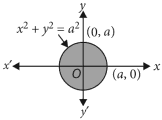
Area enclosed by the circle $x^2+y^2=a^2$ is equal to
  • A
    $2 \pi a^2$ sq. units
  • $\pi a^2$ sq. units
  • C
    $2 \pi a$ sq. units
  • D
    $\pi a$ sq. units

Answer

Correct option: B.
$\pi a^2$ sq. units
We have, $x^2+y^2=a^2$, which is a circle with centre $(0,0)$ and radius $a$.
Image
$\therefore$ Required area $=4 \times$ Area in the first quadrant
$=4 \int_0^a \sqrt{a^2-x^2} d x$
$=4\left[\frac{x}{2} \sqrt{a^2-x^2}+\frac{a^2}{2} \sin ^{-1} \frac{x}{a}\right]_0^a$
$=4\left(\frac{a^2}{2}\right) \frac{\pi}{2}$
$=\pi a^2 \text { sq. units }$

Need a full question paper?

Generate a complete, print-ready paper with questions like this in minutes — across 16+ boards, with answer keys.

Start Generating Free

Similar questions

A five $-$ digit number is written down at raddom. The probability that the number is divisible by $5,$ and no two consecutive digits are identical, is:
Choose the correct answer from the given four options.If $A$ and $B$ are two matrices of the order $3 \times m$ and $3 \times n,$ respectively and $m = n$, then order of matrix $(5A – 2B)$ is:
$\int_{}^{} {{e^{ - x}}{\rm{cose}}{{\rm{c}}^2}(2{e^{ - x}} + 5)} \;dx = $
If sum of two numbers is $3$, then maximum value of the product of first and the square of second is
Let the slope of the tangent to a curve $y=f(x)$ at $(x, y)$ be given by $2 \tan x(\cos x-y)$. if the curve passes through the point $(\frac{\pi}{4},0)$, then the value of $\int \limits_{0}^{\pi / 2} y d x$ is equal to
The shortest distance between line $y -x = 1$ and curve $x = y^2$ is
If $\text{A}=\begin{bmatrix}a^2 &\text{amp; ab}&\text{amp; ac} \\\text{ab}&\text{amp; }\text{b}^2&\text{amp;}\text{ bc}\\\text{ac}&\text{amp;}\text{bc}&\text{amp;}\text{c}^2 \end{bmatrix}$and $\text{a}^2+\text{b}^2+\text{c}^3=1$ then $\text{A}^2=$
Let $\alpha$ be a non-zero real number. Suppose $f: \mathrm{R} \rightarrow$ $\mathrm{R}$ is a differentiable function such that $f(0)=2$ and $\lim _{\mathrm{x} \rightarrow-\infty} \mathrm{f}(\mathrm{x})=1$. If $f^{\prime}(\mathrm{x})=\alpha f(x)+3$, for all $\mathrm{x} \in \mathrm{R}$, then $f\left(-\log _e 2\right)$ is equal to . . . . . . . . . 
From a set of $100$ cards numbered $1$ to $100,$ one card is drawn at randow. The probability number obtained on the card is divisible by $6$ or $8$ but not by $24$ is
If from Lagrange's mean value theorem, we have $\text{f}\ '(\text{x}_1)=\frac{\text{f}(\text{b})-\text{f}(\text{a})}{\text{b}-\text{a}},$ then :