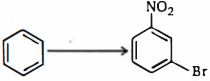
MCQ
Aromatic properties of benzene are proved by
- AAromatic sextet theory
- BResonance theory
- CMolecular orbital theory
- ✓All of these
Generate a complete, print-ready paper with questions like this in minutes — across 16+ boards, with answer keys.
$A : 1s^2\, 2s^2\, 2p^6$
$B : 1s^2\, 2s^2\, 2p^6\, 3s^2\, 3p^3$
$C : 1s^2\, 2s^2\, 2p^6\, 3s^2\, 3p^5$
for the above reaction at $298 K , K _{ c }$ is found to be $3.0 \times 10^{-59}$. If the concentration of $O _{2}$ at equilibrium is $0.040 M$ then concentration of $O _{3}$ in $M$ is ...... .

$\mathrm{A}+\mathrm{B} \rightleftharpoons 2 \mathrm{C}$
the value of equilibrium constant is $100$ at $298\, \mathrm{~K}$. If the initial concentration of all the three species is $1\, \mathrm{M}$ each, then the equilibrium concentration of $\mathrm{C}$ is $\mathrm{X} \times 10^{-1} \,\mathrm{M}$. The value of $\mathrm{x}$ is $.....$ (Nearest integer)