MCQ
Arrange the Carbocations in decreasing order of stability
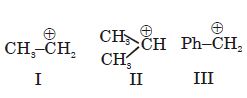
  • A
    $I > II > III$
  • B
    $I > III > II$
  • C
    $II > III > I$
  • $III > II > I$

Answer

Correct option: D.
$III > II > I$
d

Need a full question paper?

Generate a complete, print-ready paper with questions like this in minutes — across 16+ boards, with answer keys.

Start Generating Free

Similar questions

In the isoelectronic species the ionic radii $\mathop A\limits^o $ of $N^{3-}, O^{2-}$ and $F^-$ are respectively given by :-
The increasing order of basicity for the following intermediates is (from weak to strong)

$(i)$ $\begin{array}{*{20}{c}}
  {\,\,\,\,\,\,\,\,\,\,\,\,\,\,\,\,\,\,\,\,C{H_3}} \\ 
  {\,\,\,\,\,\,\,\,\,\,\,\,\,\,\,|} \\ 
  {C{H_3} - {C^ \mathbf{-} }} \\ 
  {\,\,\,\,\,\,\,\,\,\,\,\,\,\,\,|} \\ 
  {\,\,\,\,\,\,\,\,\,\,\,\,\,\,\,\,\,\,C{H_3}} 
\end{array}$

$(ii)$ $H _{2} C = CH - CH _{2}$

$(iii)$ $HC \equiv \stackrel{\ominus}{ C }$

$(iv)$ $\stackrel{\ominus}{ CH _{3}}$

$(v)$ $\stackrel{\ominus}{{ }_{ CN }}$

The $IUPAC$ name of $C{H_3} - C{H_2}CH = \mathop {\mathop {CC{H_2}OH}\limits_{|\,\,\,\,\,\,\,\,\,\,\,\,\,\,\,\,} }\limits_{C{H_3}\,\,\,\,\,\,\,\,\,\,\,} $ will be
 Which of the following is not in accordance to IUPAC system?
Most reactive towards $EAR$
According to Lewis concept which one of the following is not a base
$50\, mL$ of $0.1\, M$ solution of a salt reacted with $25\, mL$ of $0.1\, M$ solution of sodium sulphite. The half reaction for the oxidation of sulphite ion is

$SO{{_{3}^{2-}}_{\left( aq. \right)}}+{{H}_{2}}{{O}_{\left( l \right)}}\to SO{{_{4}^{2-}}_{\left( aq. \right)}}+2{{H}^{+}}_{\left( aq. \right)}+2{{H}^{+}}_{\left( aq. \right)}+2{{e}^{-}}$

If the oxidation number of metal in the salt was $+3$, what would be the new oxidation number of metal?

All natural processes are:
Which of the following statements is not correct for a nucleophile?
The series of lines appearing in UV region of electromagnetic spectrum of hydrogen is called: