Question
Arrange the given fraction in descending order by making numerator equal:
$\frac{3}{7}, \frac{4}{8}, \frac{5}{7} \text { and } \frac{8}{11}$

Answer

$ \frac{3}{7}, \frac{4}{8}, \frac{5}{7} \text { and } \frac{8}{11} $
L.C.M. of numerators $3,4,5$ and $8=120$
$ \begin{aligned} & \therefore \frac{3}{7}=\frac{3 \times 40}{7 \times 40}=\frac{120}{280} \\ & \frac{4}{9}=\frac{4 \times 30}{9 \times 30}=\frac{120}{270} \\ & \frac{5}{7}=\frac{5 \times 24}{7 \times 24}=\frac{120}{168} \\ & \frac{8}{11}=\frac{8 \times 15}{11 \times 15}=\frac{120}{165} \end{aligned} $
It is clear from the above that
$ \begin{aligned} & \frac{120}{165}>\frac{120}{168}>\frac{120}{270}>\frac{120}{280} \\ & \text { or } \frac{8}{11}>\frac{5}{7}>\frac{4}{9}>\frac{3}{7} \end{aligned} $
Hence, $\frac{8}{11}, \frac{5}{7}, \frac{4}{9}, \frac{3}{7}$ are in descending order.

Need a full question paper?

Generate a complete, print-ready paper with questions like this in minutes — across 16+ boards, with answer keys.
Start Generating Free

Similar questions

Prove that:
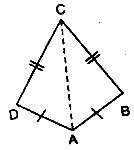
(i) $\triangle A B C \cong \triangle A D C$
(ii) $\angle B=\angle D$
(iii) $A C$ bisects angle $D C B$
A ladder, 6.5 m long, rests against a vertical wall. If the foot of the ladder is 2.5 m from the foot of the wall, find up to how much height does the ladder reach?
A sum amounts to Rs. 2,652 in 6 years at 5% p.a. simple interest. Find:
(i) the sum
(ii) the time in which the same sum will double itself at the same rate of interest.
Using ruler and compasses, construct the following angle:
75°
The difference between two numbers is 7. Six times the smaller plus the larger is 77. Find the numbers.
Solve: 21 – 3 (x – 7) = x + 20
The base angle of an isosceles triangle is 15° more than its vertical angle. Find its each angle.
Simplify : $1 \frac{1}{2} \times 2 \frac{3}{4} \div 1 \frac{4}{7}$ of $2 \frac{5}{8}$
In India, the Census is held every 10 years to count the whole population of the country. In a particular Census, the data of the number of children in 25 families of a village was provided as :
1, 2, 4, 2, 0, 2, 3, 3, 1, 0, 2, 3, 4, 3, 1, 1, 2, 1, 2, 3, 2, 4, 1, 2, 2.
Rahul works in the analytics department of the Census. He was given the task of analysing this data of the 25 families of this village.
Q.1. How many families have 3 children?
(a) 2 $\quad$$\quad$(b) 3$\quad$$\quad$ (c) 5$\quad$$\quad$ (d) 6
Q.2. The cumulative frequency of families having 3 children is :
(a) 13$\quad$$\quad$(b) 17$\quad$$\quad$ (c) 18$\quad$$\quad$ (d) 22
Q.3. The mean number of children in these 25 families is :
(a) 1.96 $\quad$$\quad$(b) 2.04$\quad$$\quad$ (c) 2.85$\quad$$\quad$ (d) 3.15
Q.4. The median of the number of children in these 25 families is :
(a) 1 $\quad$$\quad$(b) 2 $\quad$$\quad$(c) 3$\quad$$\quad$ (d) 4
The selling price of an article is Rs. 1,200 and cost price is $\frac{5}{4}$ times of its selling price, find:
(i) cost price of the article ;
(ii) profit or loss as percent.