MCQ
Artificial radioactivity was discovered by:
  • A
    Klaproth. 
  • B
    Rontgen.
  • C
    Irene Curie and Joliot.
  • D
    P. Curie and M. Curie.

Answer

  1. Irene Curie and Joliot.

Need a full question paper?

Generate a complete, print-ready paper with questions like this in minutes — across 16+ boards, with answer keys.
Start Generating Free

Similar questions

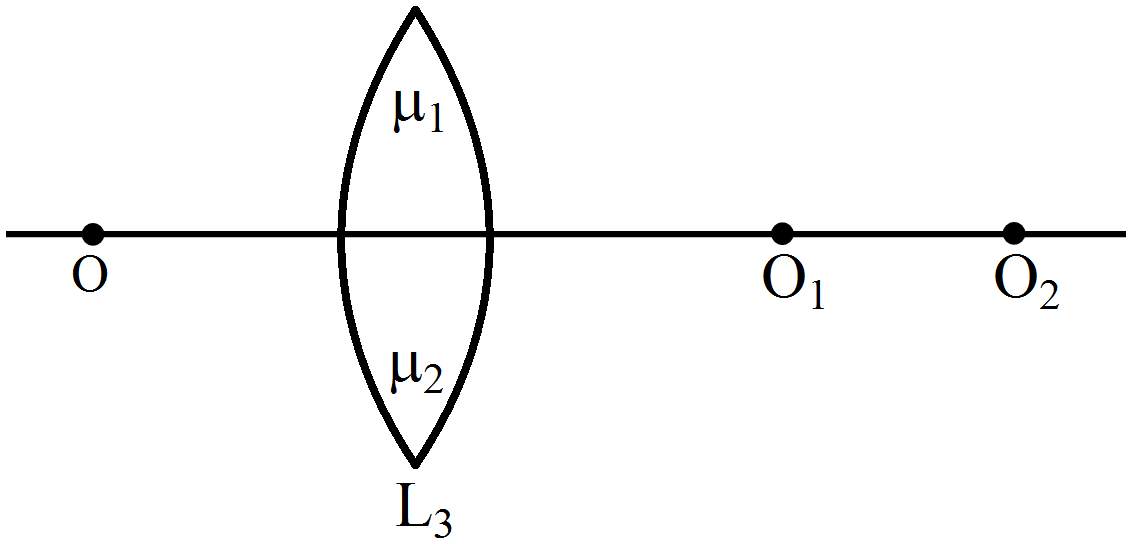
Consider three converging lenses L1, L2 and L3 having identical geometrical construction. The index of refraction of L1 and L2 are $\mu_1$ and $\mu_2$ respectively. The upper half of the lens L3 has a refractive index $\mu_1$ and the lower half has $\mu_2$. A point object O is imaged at O1 by the lens L1 and at O2 by the lens L2 placed in same position. If L3 is placed at the same place:

  1. There will be an image at O1
  2. There will be an image at O2
  3. The only image will form somewhere between O1 and O2
  4. The only image will form away from O2.

A man runs towards a mirror at a speed 15 m/s  The speed of the image relative to the man is

(a) 15  

(b) 30  

(c) 35

(d) 20

Let r be the distance of a point on the axis of a bar magnet from its centre. The magnetic field at such a point is proportional to:

  1. $\frac{1}{\text{r}}$

  2. $\frac{1}{\text{r}^2}$

  3. $\frac{1}{\text{r}^3}$

  4. None of these.

The polarisation is measured in:
At magnetic poles, the angle of dip is:

A one metre long wire is lying at right angles to the magnetic field. A force of 1 kg wt. is acting on it in a magnetic field of 0.98 Tesla. The current flowing in it will be

(a) 100 A 

(b) 10 A

(c) 1 A     

(d) Zero

Positive electric flux indicates that electric lines of force are directed:

The spectral series of the hydrogen spectrum that lies in the ultraviolet region is the

(a) Balmer series

(b) Pfund series

(c) Paschen series

(d) Lyman series

Which type of a physical quantity is electric current?
A symmetric double convex lens is cut in two equal parts by a plane perpendicular to the principal axis. If the power of the original lens was 4D, the power of a cutlens will be:
  1. 2D
  2. 3D
  3. 4D
  4. 5D.