MCQ
As a wave propagates
  • A
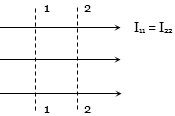
    The wave intensity remains constant for a plane wave
  • B
    Total intensity of the spherical wave over the spherical surface centered at the source remains constant at all times
  • C
    The wave intensity decreases as the inverse square of the distance from the source for a spherical wave
  • All of the above.

Answer

Correct option: D.
All of the above.
d
(d) For a travelling wave, the intensity of wave remainsconstant if it is a plane wave.
Intensity of wave is inversely proportional to the square of the distance from the source if the wave is spherical
$\left( {I = \frac{P}{{4\pi {r^2}}}} \right)$
Intensity of spherical wave on the spherical surface centred at source always remains same. Here total intensity means power $P$.

Need a full question paper?

Generate a complete, print-ready paper with questions like this in minutes — across 16+ boards, with answer keys.

Start Generating Free

Similar questions

A cylinder containing water, stands on a table of height $H$. A small hole is punched in the side of cylinder at its base. The stream of water strikes the ground at a horizontal distance $R$ from the table. Then the depth of water in the cylinder is ............
The specific heat of alcohol is about half that of water. Suppose you have identical masses of alcohol and water. The alcohol is initially at temperature $T_A$ . The water is initially at a different temperature $T_W$ . Now the two fluids are mixed in the same container and allowed to come into thermal equilibrium, with no loss of heat to the surroundings. The final temperature of the mixture will be 
A particle is rotated in a vertical circle by connecting it to a string of length l and keeping the other end of the string fixed. The minimum speed of the particle when the string is horizontal for which the particle will complete the circle is:
A particular star (assuming it as a black body) has a surface temperature of about $5 \times {10^4}K.$The wavelength in nanometers at which its radiation becomes maximum is $(b = 0.0029 mK)$
Spacing between two successive nodes in a standing wave on a string is $x$ . If frequency of the standing wave is kept unchanged but tension in the string is doubled, then new spacing between successive nodes will  become
Young's modulus is determined by the equation given by $\mathrm{Y}=49000 \frac{\mathrm{m}}{\ell} \frac{\text { dyne }}{\mathrm{cm}^2}$ where $\mathrm{M}$ is the mass and $\ell$ is the extension of wre used in the experiment. Now error in Young modules $(\mathrm{Y})$ is estimated by taking data from $M-\ell$ plot in graph paper. The smallest scale divisions are $5 \mathrm{~g}$ and $0.02$ $\mathrm{cm}$ along load axis and extension axis respectively. If the value of $M$ and $\ell$ are $500 \mathrm{~g}$ and $2 \mathrm{~cm}$ respectively then percentage error of $\mathrm{Y}$ is :
Which of the following statements is not true regarding the Newton's third law of motion?
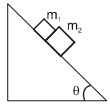
A block of mass $m_1=1 \ kg$ another mass $m_2=2 \ kg$, are placed together (see figure) on an inclined plane with angle of inclination $\theta$. Various values of $\theta$ are given in List $I$. The coefficient of friction between the block $m _1$ and the plane is always zero. The coefficient of static and dynamic friction between the block $m _2$ and the plane are equal to $\mu=0.3$. In List $II$ expression for the friction on block $m _2$ given. Match the correct expression of the friction in List $II$ with the angles given in List $I$, and choose the correct option. The acceleration due to gravity is denoted by $g$.

[Useful information : $\tan \left(5.5^{\circ}\right) \approx 0.1 ; \tan \left(11.5^{\circ}\right) \approx 0.2 ; \tan \left(16.5^{\circ} \approx 0.3\right)$ ]

List $I$ List $II$
$P.\quad$ $\theta=5^{\circ}$ $1.\quad$ $m _2 g \sin \theta$
$Q.\quad$ $\theta=10^{\circ}$ $2.\quad$ $\left(m_1+m_2\right) g \sin \theta$
$R.\quad$ $\theta=15^{\circ}$ $3.\quad$ $\mu m _2 g \cos \theta$
$S.\quad$ $\theta=20^{\circ}$ $4.\quad$ $\mu\left(m_1+m_2\right) g \cos \theta$

The spring extends by $x$ on loading, then energy stored by the spring is :(if $T$ is the tension in spring and $k$ is spring constant)
A car is moving on a circular path of radius $500\ m$ with speed $30\ m/s$ and speed is increasing at rate $2\ m/s^2$ net acceleration will be    ......... $m/s^2$