MCQ
As compared to $^{12}C$ atom $,^{14}C$ atom has:
  • A
    Two extra protons and two extra electrons.
  • B
    Two extra protons but no extra electron.
  • Two extra neutrons and no extra electron.
  • D
    Two extra neutrons and two extra electrons.

Answer

Correct option: C.
Two extra neutrons and no extra electron.
$^{12}C$ and $^{14}C$ are the two isotopes of carbon atom that have same atomic number, but different mass numbers. This means that they have same number of protons and electrons, but different number of neutrons.
Therefore $^{12}C$ has $6$ protons$, 6$ electrons and $6$ neutrons, whereas ​$^{14}C$ has $6$ electrons$, 6$ protons and $8$ neutrons.

Need a full question paper?

Generate a complete, print-ready paper with questions like this in minutes — across 16+ boards, with answer keys.
Start Generating Free

Similar questions

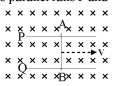
According to the figure, a conducting wire AB (length $l)$ is moving with a velocity v on two parallel rails P and Q. A uniform magnetic field is applied normally inwards to the plane of rails. Essential force needed to keep the velocity of the bar constant is:
Image
27 small drops of water with equal radius and equal charge comprised to form one big drop. The ratio of capacitance of a big drop and capacitance of a small drop will be:
How is the electric field at the surface of a charged conductor related to the surface charge density?
The transistors provide good power amplification when they are used in(a) Common collector configuration(b) Common emitter configuration(c) Common base configuration     (d) None of these
   
   
Similarities of Biot–Savart’s law and Coulomb’s law for the electrostatics are:
  1. Both are long range and inversely proportional to the square of distance from the source to the point of interest.
  2. Both are linear in source.
  3. Both are produced by scalar sources.
  4. Both follow principle of superposition.
A long solenoid has $1000$ turns per metre and carries a current of $1A.$ It has a soft iron core of $\mu r = 1000.$ The core is heated beyond the Curie temperature, $T_c.$
A particle has a mass 400 times than that of the electron and charge is double than that of a electron. It is accelerated by 5V of potential difference. Initially the particle was at rest, then its final kinetic energy will be(a) 5 eV(b) 10 eV(c) 100 eV(d) 2000 eV
       
In YDSE, the slit widths are in the ratio of 1:9. The ratio of intensity of the maxima to that of the minima is:
A film projector magnifies a $100 \ cm^2$ film strip on a screen. If the linear magnification is $4$ , the area of magnified film on the screen is
In an electron gun the control grid is given a negative potential relative to cathode in order to: