MCQ
As compared to pure atomic orbitals, hybrid orbitals have
  • Low energy
  • B
    Same energy
  • C
    High energy
  • D
    None of these

Answer

Correct option: A.
Low energy
(a) As compare to pure atomic orbitals, hybrid orbitals have low energy.

Need a full question paper?

Generate a complete, print-ready paper with questions like this in minutes — across 16+ boards, with answer keys.
Start Generating Free

Similar questions

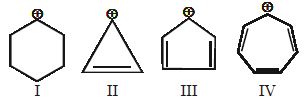
The stability of the following carbocation decreases in the order
No work is done on the system, but q amount of heat is taken out from the system and given to the surrounding. The change in internal energy of a system is
The radiation is emitted when a hydrogen atom goes from a high energy state to a lower energy state. The wavelength of one line in visible region of atomic spectrum of hydrogen is $6.5 \times 10^{-7} \, m.$ Energy difference between the two states is :
The solubility of a salt $A_2B_3$ is $10^{-3}\, M$ then what will be its solubility product ?
The number of electrons in an atom of an element is equal to its
$\text{K}_{\text{a}_1},\text{K}_{\text{a}_2}$ and $\text{K}_{\text{a}_3}$ are the respective ionisation constants for the following reactions.
$\text{H}_2\text{S}\rightleftharpoons\text{H}^++\text{HS}^-$
$\text{H}\text{S}^-\rightleftharpoons\text{H}^++\text{S}^{2-}$
$\text{H}_2\text{S}\rightleftharpoons\text{2H}^++\text{S}^{2-}$
The correct relationship between $\text{K}_{\text{a}_1},\text{K}_{\text{a}_2}$ and $\text{K}_{\text{a}_3}$ is
Maximum bond angle is present in
Which of the following is strongest Bronsted base?
Consider the following reaction

$N _{2} O _{4}( g ) \rightleftharpoons 2 NO _{2}( g ) ; \Delta H ^{0}=+58 kJ$

For each of the following cases $(a, b),$ the direction in which the equilibrium shifts is:

$(a)$ Temperature is decreased

$(b)$ Pressure is increased by adding $N _{2}$ at constant $T$

The following thermochemical reactions are given$M + \frac{1}{2}{O_2}\,\, \to \,\,MO + 351.4\,kJ$

$X + \frac{1}{2}{O_2}\,\, \to \,\,XO + 90.8\,kJ$

It follows that the heat of reaction for the following process $M + XO$ $\rightleftharpoons$ $MO + X$ is given by......$kJ$