MCQ
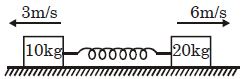
As shown in figure, two blocks are connected with a light spring. When spring was at its natural length, velocities are given to them as shown in figure. Choose the wrong alternative.
  • A
    Velocity of center of mass of the system is $3\, m/s$ (towards right)
  • B
    When spring is maximum compressed velocity of $20\, kg$ block is $3\, m/s$ (towards
    right)
  • C
    When spring is maximum elongated velocity of $10\, kg$ block is $3\, m/s$ (towards
    left)
  • Both $(A)$ and $(C)$

Answer

Correct option: D.
Both $(A)$ and $(C)$
d
$\mathrm{v}_{\mathrm{cm}}=\frac{20 \times 6-10 \times 3}{20+10}=3 \mathrm{m} / \mathrm{s}$ towards right.

At the time of either maximum elongation or compression, both the blocks will be moving with a common velocity $=3 \mathrm{m} / \mathrm{s}$ towards right.

Need a full question paper?

Generate a complete, print-ready paper with questions like this in minutes — across 16+ boards, with answer keys.

Start Generating Free

Similar questions

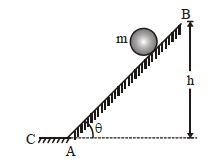
A sphere of mass $m$ comes down on a smooth inclined plane from a point $B$ at a height of $h$ from rest. The magnitude of change in momentum of the particle between the position $A$ and $C$ (assuming the angle of inclination of the plane as $\theta $ with respect to the horizontal) is
The mean free path of gas molecules depends on $(d =$ molecular diameter$)$
A body weights $49\,N$ on a spring balance at the north pole. ..... $N$ will be its weight recorded on the same weighing machine, if it is shifted to the equator?

(Use $g=\frac{G M}{R^{2}}=9.8 \,ms ^{-2}$ and radius of earth, $R =6400\, km .]$

A straight wire carrying a current ${i_1}\,amp$ runs along the axis of a circular current ${i_2}\,amp$. Then the force of interaction between the two current carrying conductors is
A damped harmonic oscillator has a frequency of $5$ oscillations per second. The amplitude drops to half its value for every $10$ oscillations. The time it will take to drop to $\frac{1}{1000}$ of the original amplitude is close to .... $s$
If solid will break under pressure greater than $13\  atm$ and that solid has a specific gravity of $4$ , what is the maximum height of a cylinder made from the solid that can be built at the earth's surface ? (Note: $1\ atm$ = $10^5\  Pa$ .) ......... $m$
Velocity of sound in air

$I.$ Increases with temperature

$II.$ Decreases with temperature

$III.$ Increase with pressure

$IV.$ Is independent of pressure

$V.$ Is independent of temperature

Choose the correct answer.

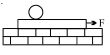
$A$ plank with a uniform sphere placed on it rests on a smooth horizontal plane. Plank is pulled to right by $a$ constant force $F$. If sphere does not slip over the plank. Which of the following is incorrect.
$Assertion :$ At a given temperature the specific heat of a gas at constant pressure. is always greater than its specific heat at constant volume

$Reason :$ When a gas is heated at constant volume some extra heat is needed compared to that at constant pressure for doing work in expansion.

A short magnet is allowed to fall along the axis of a horizontal metallic ring. Starting from rest, the distance fallen by the magnet in one second may be.....$m$