MCQ
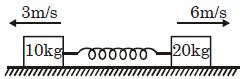
As shown in figure, two blocks are connected with a light spring. When spring was at its natural length, velocities are given to them as shown in figure. Choose the wrong alternative.
  • A
    Velocity of center of mass of the system is $3\, m/s$ (towards right)
  • B
    When spring is maximum compressed velocity of $20\, kg$ block is $3\, m/s$ (towards
    right)
  • C
    When spring is maximum elongated velocity of $10\, kg$ block is $3\, m/s$ (towards
    left)
  • Both $(A)$ and $(C)$

Answer

Correct option: D.
Both $(A)$ and $(C)$
d
$\mathrm{v}_{\mathrm{cm}}=\frac{20 \times 6-10 \times 3}{20+10}=3 \mathrm{m} / \mathrm{s}$ towards right.

At the time of either maximum elongation or compression, both the blocks will be moving with a common velocity $=3 \mathrm{m} / \mathrm{s}$ towards right.

Need a full question paper?

Generate a complete, print-ready paper with questions like this in minutes — across 16+ boards, with answer keys.

Start Generating Free

Similar questions

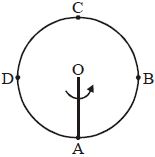
A particle tied to one end of a string is being rotated in a vertical circle with constant frequency. The tension in the string at points $A, B, C$ and $D$ are $T_1, T_2, T_3$ and $T_4$ respectively Then
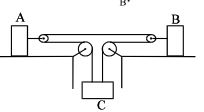
If acceleration of $A$ is $2 \,\,m/s^2$ to left and acceleration of $B$ is $1\,\,m/s^2$ to left, then acceleration of $C$ is
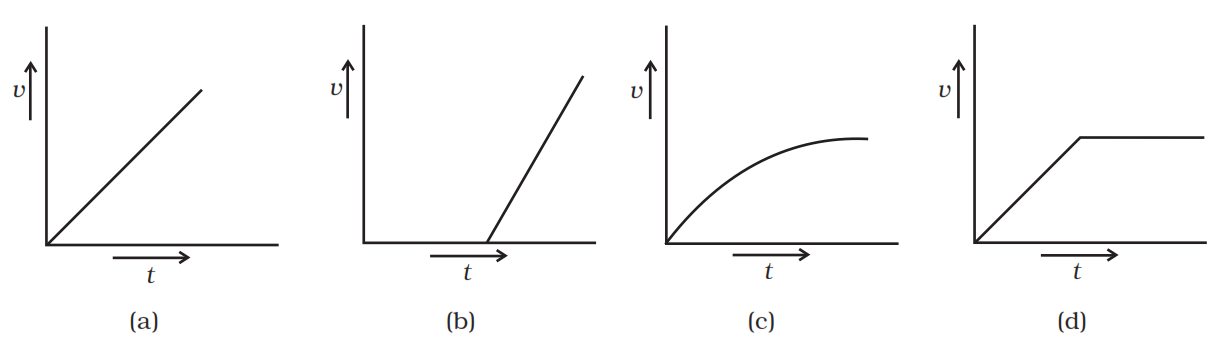
A tall cylinder is filled with viscous oil. A round pebble is dropped from the top with zero initial velocity. From the plot shown in indicate the one that represents the velocity (v) of the pebble as a function of time (t):

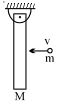
$A$ uniform rod of mass $M$ is hinged at its upper end. $A$ particle of mass $m$ moving horizontally strikes the rod at its mid point elastically. If the particle comes to rest after collision find the value of $M/m =?$
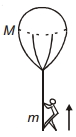
A man of mass $m$ is suspended in air by holding the rope of a balloon of mass $M$. As the man climbs up the rope, the balloon
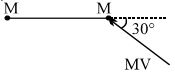
Two equal masses each of mass $M$ are joined by a massless rod of length $L$. Now an impulse $MV$ is given to the mass $M$ making an angle of $30^o$ with the length of the rod. The angular veloctiy of the rod just after imparting the impulse is
Coefficient of volumetric expansion $\alpha_\text{v}$ is not a constant. It depends on temperature. Variation of $\alpha_\text{v}$ with temperature for metals is:
A body of mass $M$ thrown horizontally with velocity $v$ from the top of the tower of height $\mathrm{H}$ touches the ground at a distance of $100 \mathrm{~m}$ from the foot of the tower. A body of mass $2 \mathrm{M}$ thrown at a velocity $\frac{v}{2}$ from the top of the tower of height $4 \mathrm{H}$ will touch the ground at a distance of. . . . ..  
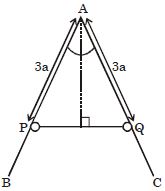
In the diagram, $BAC$ is a rigid fixed rough wire and angle $BAC$ is $60^o$. $P$ and $Q$ are two identical rings of mass $m$ connected by a light elastic string of natural length $2a$ and elastic constant $\frac{mg}{a}$. If $P$ and $Q$ are in equilibrium when $PA = AQ = 3a$ then the least coefficient of friction between the ring and the wire is $\mu$. Then value of $\mu + \sqrt 3 $ is :-
A steel ball of radius $2\, cm$ is at rest on a frictionless surface. Another ball of radius $4\,cm$ moving at a velocity of $81 \,cm/sec$ collides elastically with first ball. After collision the smaller ball moves with speed of ............. $\mathrm{cm} / \mathrm{sec}$