Question
As the mass number A increases, the binding energy per nucleon in a nucleus:
  1. Increases.
  2. Decreases.
  3. Remains the same.
  4. Varies in a way that depends on the actual value of A.

Answer

  1.  Varies in a way that depends on the actual value of A.

Explanation:

Binding energy per nucleon in a nucleus first increases with increasing mass number (A) and reaches a maximum of 8.7MeV for A (50 - 80). Then, again it slowly starts decreasing with the increase in A and drops to the value of 7.5MeV.

Need a full question paper?

Generate a complete, print-ready paper with questions like this in minutes — across 16+ boards, with answer keys.

Start Generating Free

Similar questions

A fully charged capacitor has a capacitance ‘C’. It is discharged through a small coil of resistance wire embedded in a thermally insulated block of specific heat capacity ‘s’ and mass ‘m’. If the temperature of the block is raised by ‘ T ’, the potential difference ‘V’ across the capacitance is

(a)   

(b)  

(c)

(d)

If the net electric flux through a closed surface is zero, then we can infer:

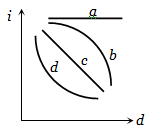
A point source of light is used in an experiment on photoelectric effect. Which of the following curves best represents the variation of photo current (i) with distance (d) of the source from the emitter

(a) a 

(b) b

(c) c  

(d) d

Gauss’s law is true only if force due to a charge varies as

(a)  

(b)  

(c)  

(d)  

The maximum velocity of an electron emitted by light of wavelength λ  incident on the surface of a metal of work function ,  is (Where h = Planck's constant, m = mass of electron and c = speed of light.)

(a)

(b) 

(c)

(d)

In vacuum an electron of energy 10 keV hits tungsten target, then emitted radiation will be       

(a) Cathode rays

(b) X-rays

(c) Infrared rays

(d) Visible spectrum

Coherent sources of light produce constructive interference while there is a phase difference between them is :

An object placed 10 cm in front of a lens has an image 20 cm behind the lens. What is the power of the lens (in dioptres)

(a) 1.5

(b) 3.0

(c) – 15.0

(d) + 15.0

A radio isotope has a half life of 75 years. The fraction of the atoms of this material that would decay in 150 years will be

(a) 66.6% 

(b) 85.5%

(c) 62.5%

(d) 75%

Deviation of 5° is observed from a prism whose angle is small and whose refractive index is 1.5. The angle of prism is

(a) 7.5°

(b) 10°

(c) 5°

(d) 3.3°